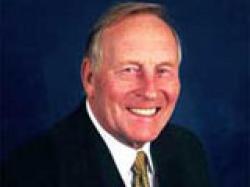
Robert S. Stevens
 USA
USA- Biography of Robert C. Stevens
- Early Life and Education
- Political Career and Business Ventures
- Railroad and Later Life
Biography of Robert C. Stevens
Robert C. Stevens was an American politician, banker, railroad executive, lawyer, and senator from the state of Kansas. He also served as a representative from the state of New York. Stevens was a successful entrepreneur who participated in several congressional elections, winning once and serving from March 4, 1883, to March 3, 1885. However, he did not win re-election.
Early Life and Education
Robert Wadley Smith Stevens was born on March 27, 1824, in Attica, New York. He was the only son of Judge Alden Sprague Stevens and Achsa Smith Stevens. Stevens initially prepared to attend college but had to end his education due to financial difficulties. He continued to educate himself while working as a clerk at an auction house and the local post office. In 1844, he obtained a teacher's certificate. While teaching, Stevens studied law, and in 1846, he passed the bar exam to become a lawyer. He opened a law practice in Attica and also engaged in various commercial ventures.
Political Career and Business Ventures
Stevens became acquainted with Ohio Governor Wilson Shannon and moved to Kansas in 1856, initially practicing law alongside Shannon. He later invested in real estate development, coal mining, and the construction and operation of railroads. As a Democrat, Stevens supported James Buchanan in the 1856 presidential election. After Buchanan's victory, Stevens was appointed as a special commissioner and organized the sale of lands acquired by the United States from the KasKaskia, Peoria, Piankashaw, and Wea tribes in 1854.
In 1858, Stevens became the mayor of Lecompton and served as a senator of the state of Kansas from 1862 to 1863. During his time as a senator, Stevens was almost implicated in the impeachment proceedings against Governor Charles L. Robinson for alleged involvement in a bond sale scandal. However, Governor Robinson was ultimately acquitted.
Stevens later participated in a government-sanctioned commercial development project for the Sauk and Fox Indian reservations. The project aimed to build wooden houses, sawmills, and small factories. However, the local residents opposed the project, preferring to maintain their traditional way of life. Stevens lost a significant portion of his fortune during this venture, and the federal government was unable to compensate him as specified in the contract. It took him twenty years to repay his debts.
Railroad and Later Life
In 1862, Stevens relocated to Lawrence and became the president of a local bank. He courageously tried to prevent an attack by pro-Confederate guerrillas during the infamous Lawrence Massacre. Six years later, Stevens won a contract to build the Missouri-Kansas-Texas railroad, the first railway to reach the Indian Territory (now Oklahoma), and later extended to Texas. As the construction leader and later the general manager of the railroad, Stevens was responsible for the development of towns such as Parsons, Kansas, and Denison, Texas, along the railway route. The railroad became a prosperous enterprise, and Stevens, having become wealthy, was finally able to settle his debts by the late 1870s.
In 1879, Stevens retired and returned to Attica, where he spent his remaining years as a gentleman farmer. He invested in local businesses, including railroads, and actively participated in community life. Stevens built a local library named after him, modernized several schools, and restored a Presbyterian church. He passed away on February 23, 1893, in Attica.
Stevens married Mary Proctor Smith, a distant relative whose family owned a successful sawmill business, in 1852. They had a son named Frederick C. Stevens, who later became a senator in the state of New York and served as the superintendent of public works.