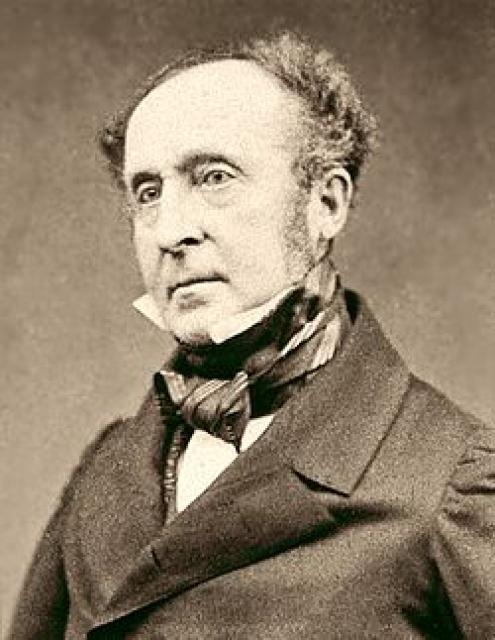
Roderick Murchison
 Great Britain
- Early Life and Military Career
- Post-War and Geological Pursuits
- Geological Discoveries
- Later Career and Legacy
Early Life and Military Career
RodERICK Impey Murchison was born on February 19, 1792, in Tarradale, Ross-shire, Scotland. He received his early education at Durham School, a Latin grammar school, and later attended the Great Marlow Military College.
In 1807, Murchison was commissioned as an ensign in the 36th Regiment of Foot. He served in the Peninsular War under Arthur Wellesley, the Duke of Wellington, in Galicia in 1808. Later, he participated in the retreat to La Coruña under General John Moore.
Post-War and Geological Pursuits
After the Battle of Waterloo, Murchison demobilized from the army and settled in England in 1818. He became active in the Geological Society of London and in 1825 presented a paper entitled "Geological Sketch of the Northwestern Extremity of Sussex and the Adjoining Parts of Hants and Surrey." In 1826, he was elected a Fellow of the Geological Society.
Geological Discoveries
Murchison's systematic study of fossils in the Paleozoic rocks of England and Wales led him to identify a distinct period, which he named the Silurian period, in 1835. In 1839, in collaboration with Adam Sedgwick, he established the Devonian period of the Paleozoic era, which lies between the Silurian and Carboniferous periods.
In 1841, Murchison proposed the Permian period of the Paleozoic era based on his research in Russia. He also predicted the presence of gold deposits in Australia in 1844 after comparing his findings from the Ural Mountains with geological formations found there.
Later Career and Legacy
In 1855, Murchison became the Director-General of the Geological Survey and Director of the Royal School of Mines. He was also a founder and several-time President of the Royal Geographical Society. He established the Chair of Geology and Mineralogy at the University of Edinburgh.
Murchison authored numerous scientific articles and several books. He passed away in London on October 22, 1871.
In his will, Murchison established the Murchison Fund and Medal of the Geological Society of London, which is awarded annually for outstanding work in geology. The extinct genus of gastropod mollusks, Murchisonia, and the mineral murchisonite (a variety of orthoclase) were named in his honor.