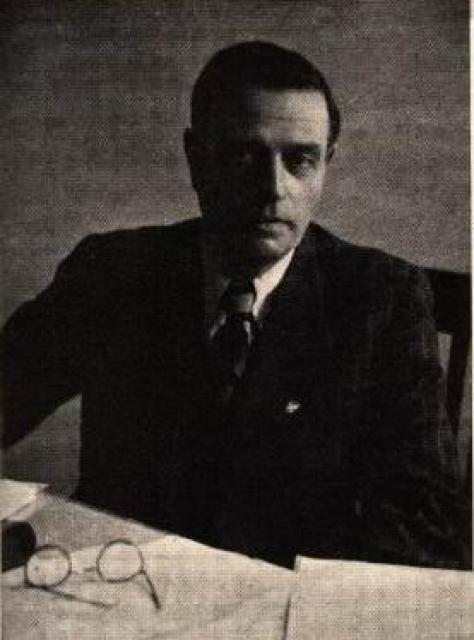
Rodoslav Ostrovskiy
 USA
USA- The Early Years of a Controversial Figure
- Arrests and Imprisonment
- Teaching Career
- Political Activism in the Early 20th Century
- Opposition to the Bolsheviks
- Exile in Western Belarus
- Political Transformation in Western Belarus
- Involvement with the Communist Party
- Arrest and Trial
- Return to Polish Collaboration
- Electoral Success and Criticism
- World War II and the Belarusian Central Council
- President of the Belarusian Central Council
- Military Collaboration
- Post-War Exile and Legacy
- Ideological Leader of the BCC
- Death in New Jersey
The Early Years of a Controversial Figure
Childhood and EducationRadosław Mikołajczyk was born on October 25, 1887, in the village of Zapole, Minsk Governorate, Russian Empire (present-day Belarus). He attended Slutsk Gymnasium but was expelled for his involvement in the Russian Revolution of 1905-1907. In 1908, he enrolled in the Mathematics Faculty of Saint Petersburg University.
Arrests and Imprisonment
In 1911, Mikołajczyk was arrested for participating in student protests. He spent time in prisons in Saint Petersburg and Pskov. Upon his release, he resumed his studies at the university and later transferred to the University of Tartu, where he completed the Faculty of Physics and Mathematics.
Teaching Career
After graduation, Mikołajczyk worked as a teacher in Częstochowa, Poland, and Minsk. From 1915 to 1917, he taught at the Minsk Teachers' Institute.
Political Activism in the Early 20th Century
Commissioner for Slutsk CountyFollowing the February Revolution of 1917, Mikołajczyk was appointed Commissioner for Slutsk County by the Provisional Government. He also founded the Slutsk Belarusian Gymnasium and served as its director.
Opposition to the Bolsheviks
Mikołajczyk opposed the October Revolution of 1917. He represented Belarus at the First All-Belarusian Congress and advocated for Belarusian independence in the press. He participated in the Slutsk Uprising of 1920.
Exile in Western Belarus
In 1921, Mikołajczyk moved to Western Belarus, which was under Polish rule. From 1924 to 1936, he served as the director of the Vilna Gymnasium.
Political Transformation in Western Belarus
Collaboration with Pro-Government GroupsIn the mid-1920s, Mikołajczyk drastically changed his political views. He became an advocate for collaboration with the Polish government, inspiring the creation of the Polish-Belarusian Society in 1924.
Involvement with the Communist Party
After the dissolution of the Society, Mikołajczyk briefly collaborated with the Belarusian Communist Party (Bolsheviks) and the Communist Party of Western Belarus. He also supervised the underground Komsomol in his gymnasium.
Arrest and Trial
In 1926, Mikołajczyk joined the Communist Party of Western Belarus. He was arrested by Polish authorities but was acquitted in a trial against the party.
Return to Polish Collaboration
Shift in Political OrientationOnce again, Mikołajczyk reversed his political course in 1928. He advocated for cooperation with the Polish government, alienating many figures in the Western Belarusian national movement.
Electoral Success and Criticism
In 1934, he was elected to the Polish Sejm (parliament). Under the pseudonym "Era," he published articles in various Belarusian publications, promoting Polish collaboration.
World War II and the Belarusian Central Council
Collaboration with Nazi GermanyWith the outbreak of World War II, Mikołajczyk became the head of the Minsk District Administration. He established administrations in Bryansk, Smolensk, and Mogilev, serving as their mayor.
President of the Belarusian Central Council
In 1943, Mikołajczyk was appointed head of the Belarusian Trust Committee, created by the German occupation authorities. After the declaration of the Belarusian Central Council (BCC) in Minsk on December 21, 1943, he became its president.
Military Collaboration
With the approval of the occupation authorities, Mikołajczyk formed the Belarusian Territorial Self-Defense (BKO) in 1944. Franz Koushel was appointed its commander.
Post-War Exile and Legacy
Emigration to the WestAfter the war, Mikołajczyk lived in exile, initially in West Germany and later in the United States. He was a member of the leadership of the Anti-Bolshevik Bloc of Nations.
Ideological Leader of the BCC
Mikołajczyk was the main ideological proponent of the BCC as the legitimate Belarusian government in exile. He denied the status of the Rada of the Belarusian Democratic Republic (BDR).
Death in New Jersey
Radosław Mikołajczyk died on October 17, 1976, in South River, New Jersey, USA.


