Roger Bacon
 Great Britain
Biography of Roger Bacon
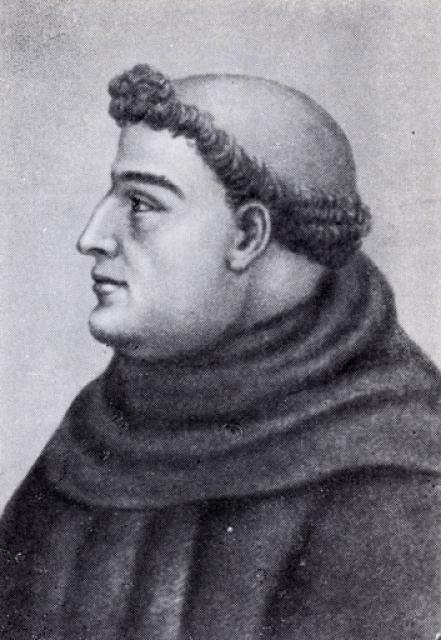
Roger Bacon was an English scientist known for advocating the experimental method in science. He was born near Ilchester in Somerset, around 1214. Bacon received his education at Oxford and Paris and taught at the University of Oxford and the University of Paris. He was involved in alchemy, astrology, and optics, and was the first in Europe to describe the technology of making gunpowder in 1240. He became a monk around 1257 and lived in a Franciscan monastery in Paris.
Opus maius and Other Works
Bacon had a critical view of the academic science of his time and invented a plan and method for the reform of sciences. At the request of Pope Clement IV, he outlined his ideas in his famous treatise "Opus maius". He also wrote other works such as "Opus secundus", "Opus minus", and "Opus tertium" in the 1260s, as well as many others. Pope Clement IV died in 1268.
Imprisonment and Later Life
Bacon was accused of heresy and imprisoned in a monastery in 1278. He was released in 1292 and died in Oxford on June 11, 1294. His works mainly consist of fragmented encyclopedic studies that reflect the level of knowledge in the medieval era. His original philosophical ideas are presented in "Opus maius". His main teaching is purely medieval in character, stating that all wisdom comes from God and has three sources of revelation: Scripture, observation of nature, and the inner light of the soul obtained through the ascent of seven steps of "inner experience". The necessary tools for understanding these three types of revelation are knowledge of languages, mathematics, and moral and spiritual disciplines. However, knowledge is achieved and verified only through "experimental science", which Bacon considers the application of theory to practical work - discoveries and inventions that are useful for material well-being, as well as moral and spiritual work leading to eternal bliss.
Legacy
Bacon is known for his eloquent appeals to the experimental method in science. However, a careful analysis of his works reveals that he had a poor understanding of what the experimental method truly meant and his knowledge of science was not superior to other monks. Bacon's works, many of which have come down to us in encrypted form, had relatively little impact on the subsequent intellectual history.