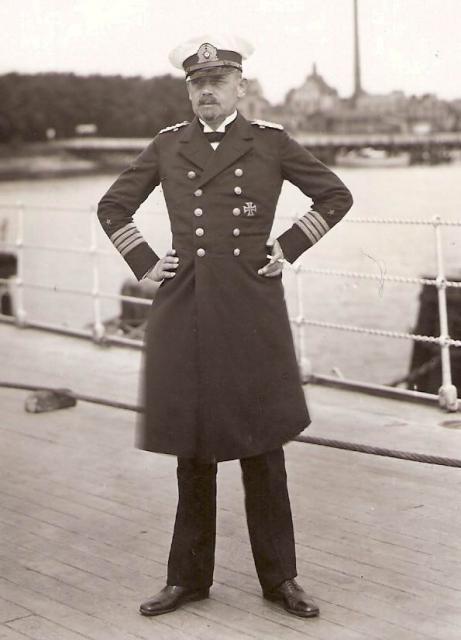
Rolf Carls
 Germany
- Early Career
- World War I and Submarine Command
- Post-War Career and Rise Through the Ranks
- Rise to Prominence
- Later Career and Legacy
Early Career
Karl Dönitz, a prominent German naval figure, commenced his service in the Kaiserliche Marine (Imperial Navy) as a cadet on 1 May 1903. Graduating from naval academy with specialized training, he sailed with the East Asian Squadron in 1905. From November 1905 onwards, he served aboard surface ships, achieving the rank of lieutenant on 28 September 1906.
World War I and Submarine Command
During World War I, Dönitz served as an artillery officer on the light cruiser "Breslau" from 13 May 1914, participating in operations on the Black Sea. Promoted to captain-lieutenant on 16 December 1914, he transitioned to the battleship "König" as its third artillery officer on 16 January 1917. In April-June 1917, he underwent submarine training.
From 1 July 1917, Dönitz became an instructor at the school on the armored cruiser "Kaiserin Augusta." He took command of the submarine U-9 on 31 May 1918, followed by U-124 from 21 July to 1 December 1918. For his combat achievements, he was awarded the Iron Cross, 1st and 2nd class.
Post-War Career and Rise Through the Ranks
After demobilization, Dönitz remained in the navy, commanding the 8th Marine Artillery Battalion from 9 February 1919. He served at the disposal of the Inspector of the Submarine Fleet from 16 March 1919 and commanded the 3rd Marine Brigade from 9 April 1919. Assuming command of the 5th Coastal Defense Battalion on 1 July 1920, he later became the first artillery officer of the battleship "Hannover" on 8 October 1923.
On 10 September 1925, Dönitz was appointed Director of the Imperial Naval Service in Königsberg. He was transferred to the Fleet Department of the Naval Administration on 18 March 1927, becoming Head of the Combat Training Department on 5 October 1928.
Rise to Prominence
On 1 May 1930, Dönitz attained the rank of captain and became Chief of Staff of the Naval Administration on 1 October 1930, becoming one of Erich Raeder's closest aides. From 29 September 1934 to 30 September 1936, he commanded battleships.
Dönitz had superior command of the German Navy during the Spanish Civil War in 1936-37, concurrently serving as the Commander of the Navy in Spain (24 July-26 August, 5 October-13 November 1936, and 3 August-7 September 1937). From 1 October to 23 November 1936, he commanded the armored forces. Finally, from 1 January 1937 to 17 June 1938, Dönitz served as the Commander of the Navy.
Later Career and Legacy
On 1 November 1938, Dönitz became the Chief of the "Ostsee" Naval Station, and from 31 October 1939, he commanded the Navy Group "Ost" (later renamed "Nord" on 10 August 1940). Dönitz was instrumental in the plan to capture Norway and its naval bases, convincing Raeder of the necessity of the operation.
On 14 June 1940, he was awarded the Knight's Cross of the Iron Cross. After the death of fleet commander Admiral Günther Lütjens in May 1941, Dönitz temporarily led the fleet while retaining command of the Navy Group until Otto Schniewind's appointment.
Considered one of the most influential admirals in the German Navy, Dönitz was nominated as a potential successor to Raeder upon the latter's retirement in January 1943. However, Karl Dönitz became his successor instead. He earned the nickname "Sea King" among sailors for his highly respected leadership qualities.
On 2 March 1943, Dönitz was relieved of all positions and assigned to the disposal of the Commander-in-Chief of the Navy. He was retired on 31 May 1943 and later died during an Allied air raid.


