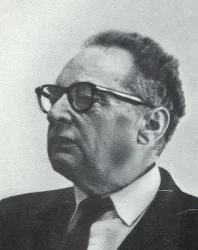
Roman Jakobson
Early interests and exile
Roman Jakobson was born in Moscow on 11 October 1896. Fascinated from childhood by language, folklore, and poetry, he studied at Moscow University and became involved in the Russian Formalist movement, which examined how literary works create meaning through their forms and techniques.
The Russian Revolution and ensuing political changes shaped his career. Jakobson left Russia in 1920 and settled in Prague, where he became a central member of the Prague Linguistic Circle, founded in 1926. There he worked with fellow linguists, especially Nikolai Trubetzkoy, to develop structural approaches to language. As political conditions worsened in Europe, Jakobson left Czechoslovakia in 1939 and eventually emigrated to the United States in 1941.
Language as a system
Jakobson helped make phonology—the study of sound systems—a central part of modern linguistics. Rather than treating speech sounds as isolated units, he analyzed how they function through contrasts within a language. His work on distinctive features showed how sounds could be described through oppositions such as voiced and voiceless, or nasal and oral. This approach influenced later developments in structural and generative linguistics.
His interests ranged well beyond sound. Jakobson wrote on Slavic languages, translation, child language, aphasia, poetry, and literary history. In his influential essay “Linguistics and Poetics” (1960), he described six factors involved in communication and linked them to six functions of language: referential, emotive, conative, phatic, metalingual, and poetic. The model offered a way to analyze how a message can focus on its subject, speaker, listener, channel, code, or form.
A wide-ranging legacy
Jakobson taught at Columbia University, Harvard University, and the Massachusetts Institute of Technology. His scholarship connected linguistics with literary criticism, anthropology, and semiotics, the study of signs and meaning. He was also an energetic collaborator, helping build intellectual communities in Moscow, Prague, and the United States.
He died in Cambridge, Massachusetts, on 18 July 1982. Remembered as one of the most influential linguists of the twentieth century, Jakobson broadened the study of language from grammar and historical change to sound, communication, and artistic expression.