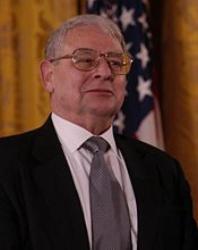
Ronert Vilson
 USA
USABiography of Robert Woodrow Wilson
Robert Woodrow Wilson, an American physicist and radio astronomer, was born in Houston, Texas. He was the only son and eldest of three children of Ralph Wilson, a chemical engineer who worked for an oil company, and Fanny May Wilson (nee Willis). As a child, Wilson often accompanied his father to oil wells and became fascinated with electronics. He earned pocket money repairing radios and televisions. In 1953, Wilson enrolled at Rice University, his father's alma mater. Initially studying radio electronics, he later shifted his focus to physics due to a lack of interest in the curriculum. He graduated with distinction in 1957 and spent the summer working at Exxon, where he obtained his first patent for a high-voltage pulse generator used in the drilling process.
In the fall of 1957, Wilson began his graduate studies at the California Institute of Technology (Caltech). During his first year, he met John Bolton, an Australian radio astronomer who came to Caltech to build an interferometer. Wilson completed his doctoral dissertation under Bolton's guidance, mapping the radio emissions from the Milky Way at a wavelength of 31 cm. He defended his thesis in 1962 and went on to do a postdoctoral fellowship at Caltech. Later, he joined the Bell Telephone Laboratories, specifically the Crawford Hill Research Laboratory in New Jersey, where he collaborated with Arno A. Penzias.
In 1960, Bell scientists built a 20-foot reflector antenna in Holmdel, New Jersey, to receive signals from the Echo satellite. When the antenna had fulfilled its purpose by 1963, Penzias and Wilson converted it into a radio astronomical telescope. Its precise calibration and extreme sensitivity made it ideal for measuring the intensity of extraterrestrial radio sources. Wilson and Penzias were also able to identify and eliminate radio noises from local sources such as the Earth's surface, atmosphere, and the antenna itself. This ability allowed them to make absolute intensity measurements of the background radiation from sky regions near their target source. Penzias had built a control source that was cooled with liquid helium to minimize thermal radiation and provide a precisely known weak signal. Wilson invented a switch to alternate the telescope amplifier between the antenna and the control source, allowing them to compare the control noise with the noises received from space.
In 1964, while working with their newly developed system, Penzias and Wilson measured signals from Cassiopeia-A, the brightest radio source in the constellation of Cassiopeia. To their surprise, they found that the background noise level exceeded their expectations. Despite their efforts to eliminate the anomalously large noise through careful calibration and measurements, they were unable to significantly reduce it. The background radiation they detected was characterized by long (radio) wavelengths, corresponding to blackbody radiation at a temperature of 3.5 degrees Kelvin (K). This unexplained background radiation became known as the cosmic microwave background (CMB).
The discovery of the CMB supported the Big Bang theory and earned Penzias and Wilson half of the 1978 Nobel Prize in Physics for "the discovery of cosmic microwave background radiation." The other half of the prize went to Pyotr Kapitsa. In his Nobel lecture, Wilson stated, "Cosmic microwave background radiation, if considered as the residual after the 'big bang' which gave rise to the universe, is one of the most powerful tools for determining the structure and dynamics of the universe."
After receiving the Nobel Prize, Wilson continued his research at the Holmdel facility, where he studied dark gas clouds in the Milky Way. He discovered that these clouds contained significant amounts of gas within our own galaxy and were the birthplaces of new stars.
In 1958, Wilson married Elizabeth Rhodes Soule, also from Houston. They have two sons and a daughter. In their free time, Wilson and his family enjoy winter sports such as skiing and ice skating. He also plays the piano.
In addition to the Nobel Prize, Wilson and Penzias received the Henry Draper Medal from the National Academy of Sciences (1977) and the Herschel Medal from the Royal Astronomical Society (1977). Wilson is a member of the American Astronomical Society, International Astronomical Union, American Physical Society, International Union of Radio Science, and the American Academy of Arts and Sciences.