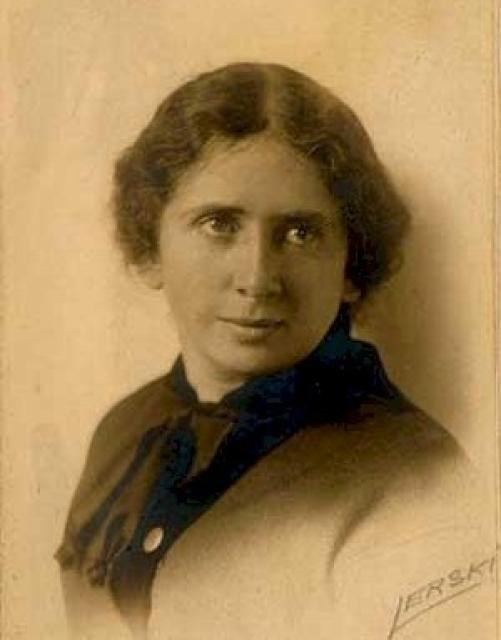
Rose Schneiderman
 USA
USAEarly Life
Rachel Schneiderman was born on April 6, 1882 (some sources say 1884 or 1886) in Sawin, a village nine miles north of Chelm in Russian Poland. She was the eldest of four children born to religious Jewish parents, Alter (later Samuel) Schneiderman and Dvoyra Roytman, who worked in the garment trade. Rachel attended the local Jewish school, typically reserved for boys, and the Russian public school in Chelm. In 1890, the Schneidermans emigrated to New York City's Lower East Side. With their father's death in the winter of 1892, the family fell into poverty.
Labor Organizing
Back in New York in 1903, Schneiderman began organizing factory workers at her own workplace. She and a coworker met the United Cloth Hat and Cap Makers Union's challenge to recruit 25 women in just a few days, securing the union's first women's local.
Elected as the first woman to the United Hatters' executive board in 1904, Schneiderman gained wider recognition during the citywide industry strike in 1905. Elected as local secretary and Central Federated Union delegate, she connected with the New York Women's Trade Union League (WTUL), which provided moral and financial support to women workers' organizing efforts. In 1908, she was elected vice president of the New York branch. Leaving her factory job, she dedicated herself to organizing for the league and to education.
Triangle Shirtwaist Factory Fire
The Triangle Shirtwaist Factory fire in 1911, where 146 mostly immigrant women workers burned to death or jumped from the ninth floor of their locked-door workplace, tragically demonstrated the urgency of Schneiderman's work. Her union, the WTUL, had documented similar dangerous conditions—such as factories without fire escapes (or with them locked during working hours)—in dozens of New York and nearby sweatshops; 25 people had recently died in a similar tragedy in Newark, New Jersey.
Schneiderman expressed her outrage at a memorial meeting for the victims held at the Metropolitan Opera on April 2, 1911, declaring in her speech that only an organized labor movement demanding safe working conditions could prevent such tragedies.
Women's Suffrage
Beginning at the First Women's Trade Union League Convention in 1907, Schneiderman had argued that political empowerment was necessary to improve workers' conditions. Accordingly, she helped the suffrage movement, largely seen as a middle-class cause led by privileged women, connect with and include the concerns of working-class women, particularly factory workers. She became a popular speaker for the organizations fighting for equal rights and the vote.
In 1912, she stumped industrial towns across Ohio for the National Woman Suffrage Association (NWSA), campaigning for the state's referendum on universal suffrage. To gain support from male workers, she emphasized that if their wives and daughters gained the vote, working people could wield significant political influence. However, the 1912 referendum failed, and it was not until 1923—after the passage of the federal 19th Amendment, which granted women the vote—that the "white male" voter restriction was removed from Ohio's state constitution.
Political Activism
In 1916–17, Schneiderman headed the industrial section of the Women's Suffrage Labor Party in New York. In 1920, she ran for the U.S. Senate on the New York Labor Party ticket (part of the Farmer-Labor Party), receiving 15,086 votes and finishing behind Prohibition and Socialist candidates. Her platform included affordable worker housing, expanded schools, nationalization of utilities, and universal health and unemployment insurance.
As a founding member of the American Civil Liberties Union, she became friends with Eleanor Roosevelt and her husband, Franklin D. Roosevelt. Following his election as president, she supported the New Deal. In 1933, she was the only woman appointed by the president to the National Recovery Administration's Labor Advisory Board and served as a member of Roosevelt's "brain trust" throughout the decade. From 1937 to 1944, she served as New York State's secretary of labor, working to extend social security benefits to domestic workers and fight for equal pay for women workers.
Legacy
Rose Schneiderman is credited with coining one of the most memorable phrases of the labor and women's movements of her time: "Bread and Roses." Associated with the 1912 textile strike in Lawrence, Massachusetts, in which mostly immigrant women workers participated, the slogan was later used as the title of a song by James Oppenheim set to music by Mimi Fariña and widely performed by artists including Judy Collins and John Denver.
Schneiderman retired from active public life in 1949, although she occasionally spoke on radio and to union audiences. She dedicated her time to writing her memoirs and published her account of the women's labor movement, "All for One," in 1967.
Never married and with no children, Schneiderman treated her nieces and nephews as her own. She had a close relationship with fellow labor activist Maud O'Farrell Schwartz (1879–1937).
Rose Schneiderman died in New York City on August 11, 1972, at the age of ninety. An obituary in The New York Times declared that she had "done more than any other American to raise the status and improve the lives of women working people." It credited her with teaching Eleanor and Franklin Roosevelt "most of what they knew about trade unions" and noted her influence on the passage of the 1935 Wagner Act, the National Industrial Recovery Act, and other reforms.
In March 2011, on the hundredth anniversary of the Triangle Shirtwaist Factory fire, controversy erupted when Republican Maine Governor Paul LePage ordered the removal and relocation of an 11-panel mural in the Department of Labor building in Augusta that included a photo of Rose Schneiderman. He also ordered erasure of labor conference rooms' names, including those of Cesar Chavez, Frances Perkins, and Rose Schneiderman.