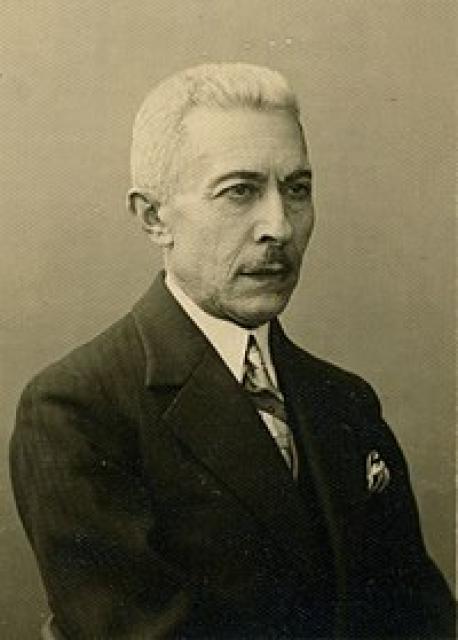
Sadyh-bek Agabekov
- Early Life and Military Career
- Service in Turkestan
- Service in Azerbaijan
- Emigration and Academic Career
- Later Years and Legacy
Early Life and Military Career
Sadikh-bey Aghabeyov, a prominent Russian military leader and Azerbaijani statesman, was born on March 15, 1865, in Goychay, Baku Governorate. He received his general education at the Baku Real School and later enrolled in the 2nd Constantine Military School in St. Petersburg in 1883. Subsequently, he transferred to the Mikhailovsky Artillery School. In 1884, as a second lieutenant, Aghabeyov was deployed to the Caucasus to continue his service in the Kars-Alexandropol Fortress Artillery. He was promoted to lieutenant on August 14, 1888.
Service in Turkestan
In 1897, Aghabeyov was assigned to the Turkestan region, where he served as a district police chief in Andijan District from November 4, 1897. He was promoted to captain on July 19, 1898, and was awarded the Order of Saint Vladimir, 4th degree, the same year. From August 21, 1899, he served as a district police chief in Krasnovodsk District. On July 23, 1900, he became the acting assistant to the Tedjen District Chief and later served as the acting assistant and staff assistant to the Ashgabat District Chief from October 11, 1901, and November 4, 1902, respectively.
On February 24, 1904, Aghabeyov was appointed senior staff officer for special assignments to the Governor of the Transcaspian Region and was promoted to lieutenant colonel on February 26. He was further promoted to colonel on May 22, 1908. In 1914, he became the head of the Chancellery of the Governor of the Transcaspian Region of the Turkestan Governorate. He retired due to illness with the rank of major general.
During his service in Turkestan, Aghabeyov pursued his scholarly interests in Oriental studies, collecting folk tales, epics, and legends. His contributions led to the publication of his textbook, "Turkmen Dialect," for which he received a special diploma from the Emir of Bukhara.
Service in Azerbaijan
Upon retiring from the military, Aghabeyov believed his military career had come to an end and anticipated spending his remaining years in his hometown, Goychay. However, the outbreak of World War I brought changes to his plans. Honoring his oath, he volunteered for war and served on the Caucasian and Western fronts. In 1916, he returned home to live with his parents in Goychay.
On October 23, 1918, by a decision of the Azerbaijan Democratic Republic (ADR) government, Aghabeyov was appointed Deputy Minister of Internal Affairs, a post he held until December 1919. During his tenure, he developed a system of ranks for police officers. In 1919, the total number of police officers in Azerbaijan reached 9,661, including 498 first-class police officers, 5,089 second-class police officers, 242 first-class guards, and 243 second-class guards.
In October 1919, on behalf of the government, Aghabeyov met with James Harbord, the personal envoy of the US President, in Batumi. He accompanied and provided security for the envoy from October 4 to 10. Upon their arrival in Baku, General Harbord stayed at the home of Haji Zeynalabdin Taghiyev. It is said that at a banquet honoring Harbord's visit, he made a toast to Aghabeyov, despite his absence, acknowledging his exceptional intellectual abilities and commending him as the most highly educated and interesting military figure he had encountered.
Emigration and Academic Career
After the fall of the ADR, Aghabeyov and his family emigrated to Turkey, where they resided with relatives in Istanbul. He later moved to Paris, where he taught Persian and Turkish languages at the Sorbonne for two years. While in Paris, Aghabeyov experienced another tragic loss: the death of his beloved wife, Guli, who was buried in the Muslim cemetery of the French capital.
Undeterred, Aghabeyov continued his academic pursuits. At the invitation of Zygmunt Smogorzewski, he relocated to Lviv, Poland, in February 1927. There, he joined the philosophical faculty of Lviv University and taught Turkish, Persian, and Arabic languages. He also studied Polish and Ukrainian. Together with Smogorzewski and W. Kotwicz, Aghabeyov formed the core of the Oriental Studies school in Lviv, later known as the Lviv-Petersburg School.
At Lviv University, Aghabeyov taught Turkish (modern and Old Ottoman), Persian, and Arabic languages, as well as Arabic grammar, Islamic studies, Muslim paleography, calligraphy, and epigraphy. In 1931, he published his Turkish language textbook in Polish, followed by an elementary grammar of the Arabic language (phonetics and morphology) in 1932, based on the second edition of Auguste Perier's "New Grammar of the Arabic Language," published in Paris in 1928.
Aghabeyov mentored a number of students in Lviv, including Teofil Wlodzimierz, Marian Lewicki, Omeljan Pritsak, Tadeusz Lewicki, and Franciszek Machalski, among others.
Later Years and Legacy
During the Nazi occupation of Lviv, Aghabeyov was evicted from his apartment and forced to live in poorly heated quarters. In 1943, he became seriously ill and passed away on October 9, 1944, shortly after the city's liberation. Until his final days, he was cared for by his student, Olga Bak, and her husband.
Sadikh-bey Aghabeyov is buried in the 84th section of Lychakiv Cemetery in Lviv. His memory is honored in Lviv, where a street bears his name.




