Samuel de Champlain
- Early Life and the Sea
- Exploration and Cartography
- Québec and Indigenous Alliances
- Administrator and Author
- Loss and Return
- Legacy
Samuel de Champlain spent decades crossing the Atlantic, mapping waterways and arguing that France should build a lasting colony along the St. Lawrence River. His journeys helped establish Québec as the center of New France, while his alliances and military campaigns tied French expansion to the politics and conflicts of Indigenous nations. Remembered as a founder, he was also an ambitious colonial agent whose plans reshaped the region.
Early Life and the Sea
Champlain was born in Brouage, a port town in western France, probably sometime between 1567 and 1575. The exact year is uncertain: records are incomplete, and he did not leave a clear account of his birth. His family is commonly described as connected to seafaring, and he grew up in a maritime setting during a period of religious conflict and overseas expansion.
He served in the French royal army during the closing years of the Wars of Religion. After the conflict, he travelled with his uncle, a shipowner and privateer, and spent time in Spanish-controlled parts of the Americas. These experiences gave him practical knowledge of ships and navigation, and his reports attracted the attention of officials and merchants interested in France’s presence overseas.
Exploration and Cartography
In 1603, Champlain made his first recorded voyage to the St. Lawrence as part of an expedition organized under the fur-trade monopoly held by Aymar de Chaste. He travelled upriver and gathered information from Indigenous people about the geography beyond the areas Europeans had charted. His observations became the basis of Des Sauvages, a published account that mixed travel description with an argument for further French involvement.
Champlain’s work was not simply exploration for its own sake. He mapped coasts, rivers and settlements, recorded observations about the people and environments he encountered, and pressed for a permanent French colony. In 1604 he joined Pierre Dugua de Mons’s expedition to Acadia. The French established a settlement on Saint Croix Island and later moved to Port-Royal, where Champlain helped survey the coast as far south as present-day New England.
Québec and Indigenous Alliances
On 3 July 1608, under de Mons’s authority, Champlain began building a fortified settlement at Québec, where the St. Lawrence narrows. The location was strategically useful for trade and defence. What began as a small outpost became the base for French activity along the river and the enduring center of the colony.
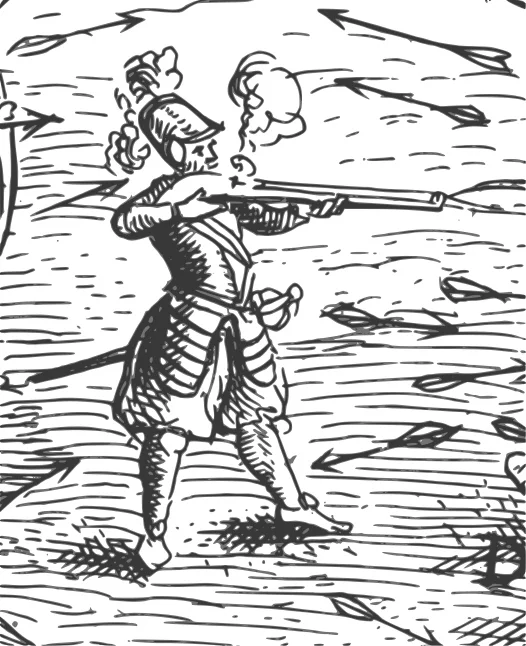
Champlain’s ambitions depended on partnerships with Indigenous communities, including Algonquin, Innu and Wendat allies. Those relationships were shaped by trade, diplomacy and mutual military interests, rather than by a single shared agenda. In 1609, he joined allied fighters in a campaign against Haudenosaunee forces near the lake later named for him. He used a firearm in the battle, killing opponents according to his own account. The alliance deepened French involvement in regional rivalries and contributed to generations of conflict.
In 1615, Champlain travelled west with a group of Recollect missionaries and reached Wendat communities near Georgian Bay. He took part in another campaign against Haudenosaunee communities and was wounded during the fighting. His writings provide important early European descriptions of parts of the region, but they also reflect the outlook of a colonial leader seeking trade, settlement and Christian conversion.
Administrator and Author
Champlain’s influence rested as much on persistence in France as on his travels. He repeatedly petitioned officials, merchants and the Crown for funding and support. In 1612, he became lieutenant to de Mons, and later served successive viceroys as the French Crown’s representative in New France. He promoted agriculture and permanent settlement alongside the fur trade, believing the colony could become more than a network of trading posts.
In 1610, Champlain married Hélène Boullé, who was twelve at the time. She joined him in Canada in 1620 and remained for about four years before returning to France. The marriage produced no children. Hélène later entered religious life and helped establish an Ursuline house at Meaux.
Champlain published successive accounts of his voyages, including an expanded work in 1613 and later volumes that recorded his travels and administrative efforts. These books, with maps and illustrations, informed French readers about the colony and supported his case for continued investment. They are also valuable historical sources, though they present events from the perspective of a European participant seeking to expand French influence.
Loss and Return
In 1629, during the war between France and England, English privateers under the Kirke brothers captured Québec after the settlement had been weakened by shortages. Champlain and many French residents were sent back across the Atlantic. The capture was a major blow to the colony and to Champlain’s career, but the Treaty of Saint-Germain-en-Laye returned Québec to France in 1632. Champlain came back the following year and resumed leadership of the settlement.
He spent his final years strengthening the colony and supporting the arrival of missionaries and settlers. Champlain died at Québec on 25 December 1635. He had crossed the Atlantic repeatedly and devoted much of his adult life to the French project in North America.
Legacy
Champlain’s maps, travel writing and political advocacy helped make Québec the anchor of New France. His record remains a major source for historians studying early European activity in the St. Lawrence region. It also documents a colonial enterprise built through Indigenous diplomacy and trade, but accompanied by warfare, missionary ambitions and territorial expansion.
The title “Father of New France” captures his central role in founding Québec, yet his legacy is more complex than a single honorific suggests. Champlain’s career linked exploration to colonization: he observed and mapped the land while working to secure it for France. The settlement he established endured, and the decisions he made continue to shape how the early history of Québec and its Indigenous nations is remembered.