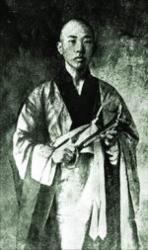
Samuel Johnson
 Great Britain
Biography of Samuel Johnson
Samuel Johnson was an English lexicographer, literary critic, essayist, and poet of the Enlightenment era. He was born on September 18, 1709 in Lichfield, Staffordshire. Johnson attended a local classical school and later went to school in Stourbridge. He worked in his father's bookshop until he entered Pembroke College, Oxford University on October 31, 1728, presumably with an inheritance. After 13 months, he ran out of money and spent two miserable years working in a bookshop. He then became a teacher at a classical school in Market Bosworth after a trip to Birmingham where he wrote his first series of essays for a local newspaper and his first book - a translation of Voyage to Abyssinia (1735) by the monk Lobo. It was during this time that he met his future wife, Elizabeth Porter, a married woman of forty-five. Her husband soon died, and on July 19, 1735, Johnson and Mrs. Porter got married. With the inheritance left by the deceased, Johnson rented a house in Edial, near Lichfield, and opened a school. However, despite the support of the locals (a young David Garrick was among his students), the school had to be closed.
In 1737, armed with recommendation letters, Johnson and Garrick set out for London in search of success. Garrick soon found his luck, but Johnson, who only had an unfinished tragedy called Irene, was not as fortunate. Finally, in 1738, he found work at the "Gentleman's Magazine," the most serious journal of the time. In May of the same year, the magazine's publisher, E. Cave, published London - Johnson's first significant work, a reworking of the third satire of Juvenal. Johnson edited the magazine and often reported on parliamentary debates using fictional names and fragmented materials since parliament forbade reporting on the debates. Johnson worked for the "Gentleman's Magazine" until 1744. In 1745, he proposed a new edition of Shakespeare, but the project failed. In 1746, Johnson began working on A Dictionary of the English Language, and in 1747, he published the Plan of the dictionary, dedicating it, as agreed, to Lord Chesterfield. In the same year, Garrick became the director of Drury Lane Theatre, and this event was marked by the brilliant production of Drury Lane Prologue by Johnson. After that, Johnson's literary endeavors struggled, but in 1749, Garrick staged Irene, Johnson's only play (a commercial success but a critical failure), and Johnson achieved his greatest success in poetry with The Vanity of Human Wishes, a reworking of Juvenal's satires.
In 1750, Johnson began publishing his most famous journal, "The Rambler," which was released twice a week until the death of his wife on March 17, 1752. In 1755, after delays from Lord Chesterfield, the Dictionary was finally published. On the title page, Johnson was referred to as a Master of Arts, a degree that Oxford University had just conferred upon him. In 1758, "The Idler," a journal of less serious intent than "The Rambler," began publication, and Johnson believed it was finally time to publish his long-awaited edition of Shakespeare. In 1758, Johnson's mother died at the age of 89. To raise money for her funeral, he hurriedly published his only novel, Rasselas, the Prince of Abyssinia. The following four years were spent in gloom and loneliness, although Johnson received a royal pension of 300 pounds sterling from 1762 onwards.
In June 1763, at Davis's bookshop, Johnson met the young James Boswell. The following year, along with a constellation of other celebrities, Johnson founded "The Club" (often referred to as "The Literary Club"). In 1765, Johnson received a Doctor of Laws degree from Trinity College Dublin, and in the same year, he released an eight-volume edition of Shakespeare. Between 1770 and 1775, four pamphlets in defense of the Tories were published, followed by a doctorate from Oxford University. Later, a group of booksellers, to whom Johnson had successfully provided advice, asked him to write prefaces for an anthology of English poets from John Milton to the mid-18th century. Johnson could not resist such an offer, and one of his major works became the Prefaces (1779-1781). In a revised form, these prefaces were published as Lives of the English Poets. The work consists of 56 articles that vary depending on Johnson's interest in the poet, ranging from biographical information and critical analysis of their major works to comprehensive studies (including Milton, Dryden, Pope, Swift, and Addison). Johnson died in London on December 13, 1784 and was buried in Westminster Abbey.
Johnson's popularity remained strong for half a century after his death. In 1787, an edition of his works in 11 volumes was published (excluding the Dictionary, Shakespeare materials, and miscellaneous publications), and in 1825, another eight volumes were released. He was admired by Walter Scott and Lord Byron, but tastes change, and in T.B. Macaulay's extensive, brilliant, and fierce critique of the Croker edition of Boswell's Life of Johnson (1831), Johnson was condemned for his Tory affiliations. Throughout his lifetime, Johnson's century of work was valued less than his conversations recorded by Boswell, although "The Rambler," "The Idler," Rasselas, and Lives of the English Poets were repeatedly reprinted. Among Johnson's poetic works, only the poems London and The Vanity of Human Wishes, theatrical prologues, and a few other minor pieces retain interest. Johnson's essays, particularly in "The Rambler" and "The Idler," follow the external models of Joseph Addison and Richard Steele, but they bear the stamp of an extraordinary personality, depth of judgment (such as on the genre of the novel and Milton), and skill in literary portraiture.
Johnson's Dictionary, two huge folio volumes, remained unrivaled for almost a century. His greatest contribution to lexicography lies in the extensive number of quotations that clarify word usage. In Lives of the English Poets, all the articles are worthy of reading, but today, the biography of Alexander Pope, containing Johnson's remarks on metaphysical poets, leaves the greatest impression.