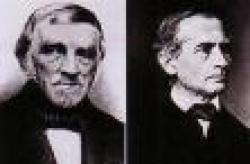
Samuel Pierpont Langley
 USA
USASamuel Pierpont Langley: American Astronomer, Physicist, and Pioneer of Aeronautics
Samuel Pierpont Langley was an American astronomer, physicist, and pioneer of aeronautics. He was born in Roxbury, Massachusetts, on August 22, 1834.
Education and Early Career
Langley graduated from Boston High School in 1851. He then worked as an engineer and architect in Chicago and St. Louis from 1851 to 1864. Subsequently, he became an assistant at the Harvard Observatory. From 1864 to 1865, he visited observatories and scientific centers in Europe.
Astronomical Contributions
Langley made significant contributions to the field of astrophysics. He invented the bolometer in 1879-1881, a device that measures radiant energy by detecting the change in resistance of a metal with temperature. Using the bolometer, he measured the energy of solar radiation across a wide range of wavelengths. He also compiled an atlas of the infrared region of the solar spectrum in 1901 and determined the solar constant.
Aeronautical Research
From 1887 to 1906, Langley pursued aerodynamic research and aircraft design. The War Department's Ordnance Bureau provided him with $50,000 to develop a flying machine. His assistant, C.M. Manly, designed a star-shaped, water-cooled gasoline engine. A quarter-scale model with a scaled-down Manly engine successfully flew, but tests of a full-scale aircraft launched from a barge on the Potomac River with Manly at the controls ended in failure. This occurred just nine days before Orville Wright's first successful flight at Kitty Hawk, North Carolina.
Later Life and Legacy
Disheartened by the failure and lacking funds for further experiments, Langley discontinued his aeronautical work. He died in Aiken, South Carolina, on February 27, 1906. Despite the setback, Langley's research laid the foundation for future advancements in aviation. He is remembered as a pioneer in the field and his innovations continue to influence the design and development of aircraft today.