Sanika Hussain
 Great Britain
- Biography of Sanika Hussein
- A Desperate Decision
- Childhood Struggles
- The Operation
- Setbacks and Recovery
- Looking to the Future
Biography of Sanika Hussein
Early Life and DiagnosisSanika Hussein, a 25-year-old British woman, became a victim of hypochondroplasia, a form of dwarfism. Standing at just 1.34 meters tall, she endured years of ridicule and bullying due to her height. The cruel taunts from her peers labeled her as a "freak." Finally, at the age of 19, doctors diagnosed her with hypochondroplasia, explaining the reason behind her 1.34-meter stature.

A Desperate Decision
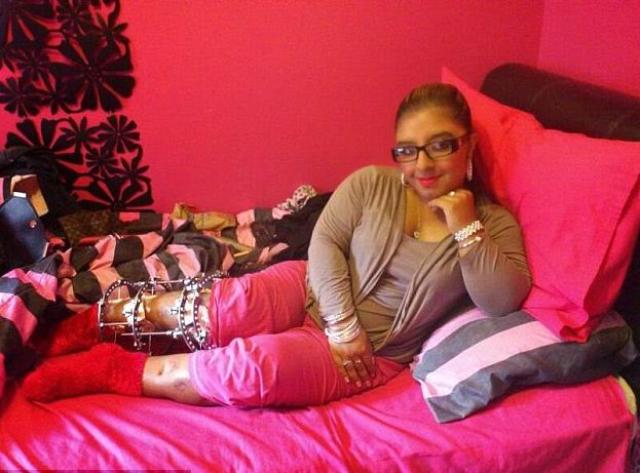
Desperately wishing to be like everyone else and match her peers, 25-year-old Sanika agreed to undergo an excruciating five-year treatment. Both her legs were broken and metal rods were inserted, stretching her legs by nearly 9 centimeters. Sanika had to lie on her back for three years, enduring the painful procedures as her bones recovered from the "barbaric" treatment. Despite the five years of agony, Sanika now claims that the additional height has made a difference. She no longer hates herself and has gained confidence in her own skin.

Childhood Struggles
Sanika, a resident of Bradford, West Yorkshire, had always known she was different. The diagnosis of hypochondroplasia, which caused her limb dwarfism, came during her teenage years. "I was noticeably shorter than my peers," recalls Sanika. "I was scared to go to school because other kids would bully me." She was constantly given nicknames, and the girls in her class kept growing taller while she remained stuck at 1.34 meters. The prefix "mini" was attached to her name by everyone in the neighborhood, impacting her self-esteem. Sanika longed to become a young woman, have friends, and a boyfriend like other girls her age, but instead, she felt completely oppressed.

The Operation
Discussing her options with a consultant from a general hospital in Leeds, Sanika learned about the possibility of limb-lengthening surgery covered by the National Health Service. The procedure would cost £8,000 and involve breaking her legs and inserting metal rods to add extra centimeters. Despite being warned about the extreme pain, Sanika understood that she had to go through it to achieve her dream. The preparation for the surgery, including blood tests, took a whole year. In November 2010, Sanika spent eight hours on the operating table in Leeds Hospital. Metal rods and screws were inserted into both her legs, and she was given special crutches to support her balance.

Setbacks and Recovery
Unfortunately, a year later, Sanika encountered a setback when she simply bent over to pick up her cat. The unfortunate movement led to serious problems in her right leg. "I was back to square one," recalls Sanika. "After a year of recovery, it was devastating. I had a new brace fitted. The pain was excruciating, and with it came fear and loneliness. I was practically bedridden and barely left my house for the following year." Despite this setback, 25-year-old Sanika did not give up on her dream. The brace on her left leg was removed in April 2014, and the remaining support was removed in May 2015. However, it took six more weeks before Sanika took her first unaided step. Finally, she felt free from the braces and looked like any other woman.
Looking to the Future
Before the operation, Sanika never even dreamed of talking to a man. She never felt attractive or confident enough to do so. Now, she is ready to try online dating. Despite the challenges she endured, Sanika believes it was all worth it. She even dreams of being able to walk in high heels someday. Hypochondroplasia affects the ossification process, transforming cartilage into bone, especially in the limbs. All affected individuals have short stature, with men ranging from 1.37 to 1.64 meters and women from 1.27 to 1.49 meters. Other characteristics of hypochondroplasia include a large head and limited range of motion in the elbows and flexibility in the legs, which often become more apparent by the mid-childhood years, around 5-7. Hypochondroplasia is a rare condition diagnosed in approximately 200 people worldwide.