Scott Nearing
 USA
USA- Scott Nearing: A Radical Economist, Educator, and Activist
- Education and Intellectual Journey
- Teaching and Scholarly Work
- Radicalization and Conflict at Wharton
- Later Life and Death
Scott Nearing: A Radical Economist, Educator, and Activist
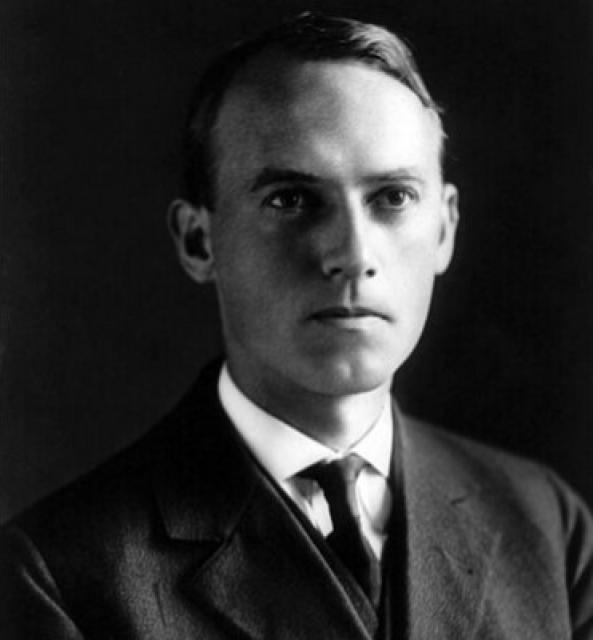
Early YearsAmerican radical economist, educator, writer, political activist, pacifist, vegetarian, and advocate of simple living, Scott Nearing was born in Morris Run, Tioga County, Pennsylvania, in the heart of the state's coal country.
His grandfather, Winfield Scott Nearing, arrived in Tioga County with his family in 1864, at the age of 35, when he took a position as a civil and mining engineer. By the end of the year, he had assumed full control of mining operations as superintendent of the Morris Run Coal Company, a position he held for the remainder of his working life.
A driven and self-motivated individual, Winfield Scott Nearing pursued studies in science and nature, indulged in gardening and carpentry, and regularly received crates of books from New York, accumulating a large personal library. In his memoirs, written late in life, Scott Nearing remembered his grandfather as one of the four most influential figures in his life.
Nearing grew up in the family of a young bourgeois, his mother hiring a part-time tutor and two Polish servants to clean the gleaming white house on the hill overlooking the town. Scott's brother recalled that the people of Morris Run treated the handsome and intelligent Scott "as they would the heir to an estate... They all stood in some awe of him."
Nearing's father was a small-scale businessman and stockbroker, his mother a lively, energetic, and idealistic woman to whom Nearing later credited instilling in him an appreciation for the finer things in life: nature, books, and art. Despite his privileged upbringing, made possible in no small part by the anti-union policies of his patriarchal grandfather, the young Scott nonetheless developed a social conscience that one biographer described as "a splinter under his skin," "which none of his relatives ever acquired and which no reasonable interpretation fully explains."
Education and Intellectual Journey
Nearing graduated from high school in 1901 and entered law school at the University of Pennsylvania, "where corporate bias so offended his idealism that he dropped out after a year." Instead, he studied public speaking at Temple University in Philadelphia and enrolled at the University of Pennsylvania's Wharton School of Business, where he immersed himself in the emerging field of economics.
At Wharton, Nearing came under the profound influence of Simon Nelson Patten, an innovative and unconventional educator and a founding father of the American Economic Association. Nearing established himself as a "Wharton Man" in the Progressive Era, one of the vaunted "best and brightest," schooled in practical economics to prepare for roles as responsible leaders of society.
According to another of his students, Patten taught the value of original thinking—"using your inventive intellect to master new situations regardless of accepted dogma." Nearing seems to have found these newfound intellectual tools for potential social change exhilarating and liberating. He completed the undergraduate program in just three years, all the while involving himself in student politics and competitive debate.
Teaching and Scholarly Work
Nearing received his B.S. from the University of Pennsylvania in 1905 and his Ph.D. in economics in 1909. From 1905 to 1907, he served as secretary of the Pennsylvania Child Labor Committee, a volunteer society dedicated to addressing the problem of child labor in the state. From 1908 to 1915, while living in Arden, Delaware, Nearing taught economics and sociology at Wharton and Swarthmore College, authoring several books on economics and social problems.
Nearing was an enthusiastic proponent of the "new economics," which insisted that "... economists quit their dreary depiction of an overpopulated and starving world, fall down before the throne of 'competition,' 'individual initiative,' 'private property,' or some other pseudo-god, and tell the people in plain and straightforward language how they can combine, change, or overcome its laws and use them as a blessing instead of enduring them as a burden and a curse."
Like Karl Marx drew radical conclusions from the ideas of the conservative Hegel, Nearing took the economic logic of his department head, Simon Patten, and drew radical conclusions about wealth and income distribution that his mentor was unwilling to do. He believed that uncontrolled great wealth stifled initiative and impeded economic progress, and he hoped that progressive thinkers in the owning class would recognize the negative impact of economic parasitism and embrace their civic duty of enlightened leadership. Nearing articulated an economic republicanism based on "the four fundamental democratic conceptions—equal opportunity, civic duty, popular government, and the rights of man."
While living in Arden in 1910, Nearing learned of "The Landlord's Game," a forerunner of Monopoly, and taught it to his students. This use of the game as a teaching tool led to its dissemination among colleges.
Radicalization and Conflict at Wharton
But Nearing's outspoken social activism in the classroom and in print brought him into conflict with his employers at the University of Pennsylvania's Wharton School of Business, leading to his dismissal and making him a star of the American radical movement for the next decade.
On the morning of June 16, 1915, Nearing was called to the phone by his secretary, who informed him that a letter had come from the provost, saying that "as your appointment as assistant professor of economics for 1914–1915 expires with the close of the present academic year, I am instructed by the board of trustees of the University of Pennsylvania to inform you that your services will not be required after the expiration of the current academic year."
The board of trustees of the University of Pennsylvania was filled with bankers, corporation lawyers, financiers, and corporate executives, and Nearing's letter did not go unnoticed. His tenuous position had been further undermined by an open letter in The North American, in which he urged the right-wing evangelist Billy Sunday to apply the Gospel to the conditions of industrial capitalism, including "the interests of railroads... traction company... manufacturers... mercenary interests."
The reaction to Nearing's dismissal from academia was swift: department head Patten and others issued statements condemning the decision. Progressives at Wharton quickly drew up a summary of the facts of the case and sent it to 1500 newspapers, magazines, and academic institutions around the country. Even conservatives on the faculty were deeply troubled, as one Wharton professor remarked, "The moment Nearing left, any conservative utterance became the spoken word of a "kept" professor." Conversely, some radicals felt vindicated in their belief in the conservative nature of the American academy. Socialist writer Upton Sinclair told Nearing in an open letter, "You do not belong in a university. You belong to the people." Nearing's dismissal has been called, in retrospect, "the most celebrated academic freedom case" of the era by one historian.
Later Life and Death
In his late 80s and 90s, Nearing's mental and physical health declined, and he was no longer able to maintain his garden. Nearing died on August 24, 1983, eighteen days after his 100th birthday. His death was planned, and he announced it to friends at a dinner party six weeks beforehand. He renounced food, and his body gradually lost all strength. He consumed fruit juices at first and limited himself to water alone the final week. He died at his home on Forest Farm in Harborside, Maine, with his wife, Helen, by his side. The details of his death were chronicled posthumously by Helen in her book, To Love and To Leave a Good Life.