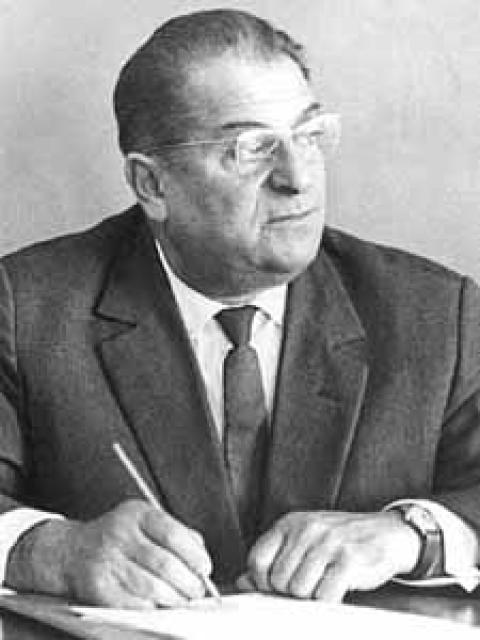
Semen Kosberg
- Semen Kosberg: A Pioneer in Rocket and Aviation Engines
- Early Life and Education
- Aviation Engine Innovations
- Wartime Contributions
- Post-War Aerospace Endeavors
- The Third Stage
Semen Kosberg: A Pioneer in Rocket and Aviation Engines
Semen Abramovich Kosberg, a distinguished Soviet engineer, made significant contributions to the development of aircraft and rocket propulsion systems. He played a pivotal role in advancing the nation's aviation and space exploration capabilities.
Early Life and Education
Born in 1903 into a Jewish blacksmith family in Belarus, Kosberg's upbringing shaped his early experiences. From 1922 to 1924, he pursued evening classes while working as a blacksmith and metal craftsman alongside his siblings. Later, he attended the Leningrad Polytechnic Institute and the Moscow Aviation Institute, graduating in 1930.
Aviation Engine Innovations
In 1931, Kosberg joined the Central Institute of Aviation Engine Building (CIAM), where he rose through the ranks to become the head of the research and development department. He revolutionized aircraft engine design by introducing direct fuel injection systems into cylinder heads, replacing inefficient carburetor-based systems. In 1940, he became deputy chief designer at Plant No. 33 and led the development of direct injection systems for aircraft engines.
Wartime Contributions
With the outbreak of World War II, Kosberg's expertise was essential. In 1941, he spearheaded the design and production of direct injection units in Berdsk, Siberia, as the chief designer of OKB-154. Under challenging conditions, his team rapidly created and mass-produced the NV-ZU direct injection unit for the Ash-82FN aircraft engine. This innovation significantly enhanced aircraft performance, providing an advantage in aerial combat against German fighters.
Post-War Aerospace Endeavors
Kosberg's work continued after the war, focusing on the development of liquid rocket engines (LREs). In 1958, he met Sergei Korolev, a pioneer in Soviet space exploration. Together, they initiated a collaboration that would propel the country's space program forward.
The Third Stage
Korolev's two-stage rocket successfully launched the first three Earth satellites. However, further space exploration required a third stage to achieve the second cosmic velocity. In a remarkable feat, Kosberg's team designed and built the third stage in just nine months. On January 2, 1959, the RD0105 engine, part of the third stage, enabled the Luna-1 satellite to become the first spacecraft to reach the second cosmic velocity and orbit the Sun.