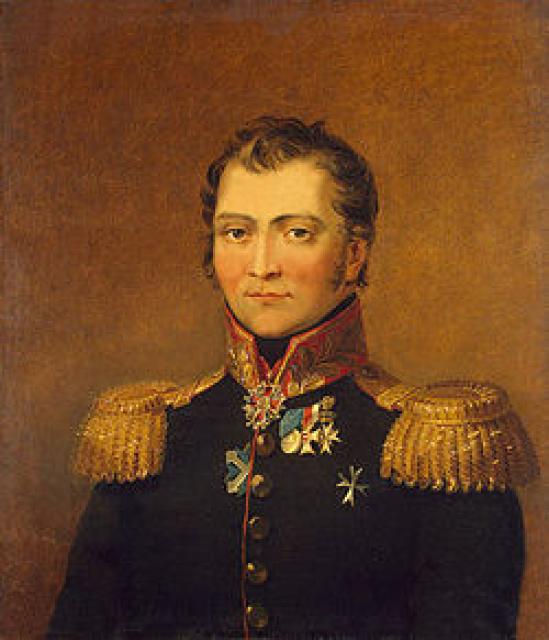
Semen Stavrakov
 Russia
- Early Life and Military Career
- Service Under Suvorov
- Italian and Swiss Campaigns
- Napoleonic Wars
- Finnish and Turkish Wars
- War of 1812 and Coalition Wars
- Post-War Career
- Legacy
Early Life and Military Career
Major General StavrakovSon of a retired lieutenant from Poltava Governorate, Stavrakov began his military service in 1783 as a corporal in the Kozelsk Musketeer Regiment. He transferred to the Tauride Grenadier Regiment in 1789 and fought against the Turks in 1790 and 1791.
Service Under Suvorov
In 1794, Stavrakov was promoted to ensign and assigned to Alexander Suvorov's staff. He participated in the Battle of Praga in 1795 and was promoted to lieutenant. In 1796, he became a staff secretary in Suvorov's headquarters and was discharged from service as a staff captain in 1797.
Italian and Swiss Campaigns
Stavrakov returned to service in 1799 and served as an adjutant to Suvorov during the Italian and Swiss campaigns. He was promoted to major, awarded the Order of Saint Anna, and distinguished himself in several battles.
Napoleonic Wars
In 1805, Stavrakov joined Mikhail Kutuzov's staff and fought in the Battles of Krems and Austerlitz. He was wounded and promoted to lieutenant colonel. In 1807, he fought with distinction at the battles of Preußisch-Eylau, Guttstadt, and Heilsberg, for which he received the Order of Saint George, 4th class. He was also wounded at Friedland and awarded a gold sword.
Finnish and Turkish Wars
Stavrakov fought in the Finnish War (1808-1809) and the Russo-Turkish War (1811). He distinguished himself in the battles of Kuortane and Orowais and was promoted to colonel in 1808.
War of 1812 and Coalition Wars
In 1812, Stavrakov was appointed commandant of the main headquarters of the First Western Army. He participated in several major battles, including Borodino, Tarutino, and Maloyaroslavets, and was promoted to major general.
In 1813 and 1814, Stavrakov continued to fight with distinction in the Coalition Wars, participating in the battles of Lützen, Bautzen, Dresden, Kulm, Leipzig, Brienne, La Rothière, Bar-sur-Aube, Arcis-sur-Aube, and the capture of Paris.
Post-War Career
After the war, Stavrakov was appointed General Quartermaster of the General Staff (1816) and Inspector of Hospitals (1816). He was known for his dedication, honesty, and sense of duty.
Legacy
Despite his extensive military service, Stavrakov is perhaps best remembered for the saying, "Without Stavrakov, one cannot fight..." A portrait of Stavrakov in the Hermitage Gallery depicts him as a younger man than his age of over fifty at the time it was painted.
Stavrakov died in St. Petersburg in 1819 and was buried in the Smolensk Orthodox Cemetery. His portrait is the only known depiction of one of Suvorov and Kutuzov's most loyal comrades.


