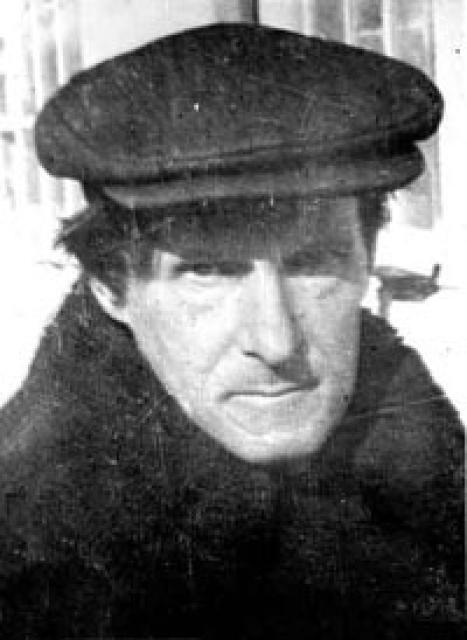
Sergey Kalmukov
 Kazakhstan
- Sergey Kalmykov: The Eccentric Visionary
- Return to Orenburg
- Move to Alma-Ata
- Experimental Techniques
- Late Life and Legacy
Sergey Kalmykov: The Eccentric Visionary
Early Life and InfluencesSergey Kalmykov was born in Samarkand, Russian Empire, in the late 19th century. His family moved to Orenburg, where he completed his secondary education. In 1909-1910, Kalmykov briefly studied in Moscow under Konstantin Yuon before moving to St. Petersburg in 1910. There, he became a pupil of Mstislav Dobushinsky and Kuzma Petrov-Vodkin. Petrov-Vodkin's famous painting "Bathing the Red Horse" is said to have been inspired by one of Kalmykov's early works.
Return to Orenburg
After the Russian Revolution, Kalmykov returned to Orenburg and worked as a decorator and parade designer. He also lectured and wrote extensively. In 1926-1928, he was a member of the Orenburg branch of the Association of Artists of Revolutionary Russia (AKhRR) and exhibited with the "Zhar-Tsvet" society.
Move to Alma-Ata
In 1935, Kalmykov moved to Alma-Ata at the invitation of the recently established Music Theater. He worked there as a set designer and illustrator until his retirement in 1962. Despite the prevailing norms of socialist realism in the USSR, Kalmykov developed a distinct and unconventional style, ranging from abstract expressionism to surrealism.
Experimental Techniques
Kalmykov experimented with various materials and canvas shapes, such as triangles and circles. He often incorporated text and always dated his paintings meticulously, even to the day and month. His "books" featured illustrations and allegorical texts. Kalmykov became known for his eccentric behavior and extravagant wardrobe, earning him legendary status in Alma-Ata.
Late Life and Legacy
Kalmykov never sold his paintings, instead gifting them sparingly. After retirement, he faced financial hardship and malnutrition. He was briefly admitted to a psychiatric hospital, where he died from pneumonia in 1971. The location of his grave is unknown. His works were dispersed after his death, with many being housed in the Central State Archive and the A. Kasteyev State Museum of Arts in Almaty.





