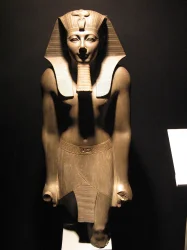
Seti I
Seti I ruled Egypt at a moment when the New Kingdom was rebuilding its power after the upheavals of the late Eighteenth Dynasty. A military campaigner and prolific builder, he restored temples, pushed Egyptian influence into the Levant, and commissioned monuments that celebrated both his gods and his royal predecessors. His son, Ramesses II, would inherit a kingdom strengthened by Seti’s work.
A New Dynasty
Seti, also written Sety, was the son of Ramesses I, founder of Egypt’s Nineteenth Dynasty, and Queen Sitre. Before becoming king, he served in military and administrative roles under his father. He took the throne around 1290 BCE, though the precise dates of his reign remain debated. His throne name, Menmaatre, reflected the language of kingship and cosmic order that shaped Egyptian royal ideology.
The dynasty’s rise followed a period of political and religious change. Earlier rulers had worked to restore traditional temples and institutions after the reign of Akhenaten and the subsequent instability. Seti continued this restoration, repairing sanctuaries and honoring older gods while presenting his family as legitimate successors to Egypt’s long royal tradition.
Campaigns and Imperial Power
Reliefs at Karnak record campaigns under Seti in Canaan and Syria, including clashes with the Shasu and with Hittite forces. Royal inscriptions portray the king as a victorious defender of Egypt’s borders and influence. These images are not neutral military reports: they were carved to express the pharaoh’s might and divine favor. Still, they offer valuable evidence for Egypt’s continued involvement in the eastern Mediterranean.
Seti also campaigned in Nubia and against groups to Egypt’s west, and he supported the development of roads, wells, mines, and quarries that helped maintain the state’s reach. His military activity set the stage for the more famous confrontation between Egypt and the Hittites during the reign of his son.
Temples and Royal Memory
Seti’s building program reached across Egypt. At Karnak, he began work on the Great Hypostyle Hall, a vast forest of columns later completed and expanded by Ramesses II. The walls carried detailed battle scenes, transforming military campaigns into a permanent statement of royal authority.
At Abydos, Seti built a richly decorated temple dedicated to Osiris and other major deities. A gallery there preserves a carefully selected list of earlier kings, linking the Nineteenth Dynasty to a long and orderly past. The list omits some rulers, reflecting the political choices involved in constructing that memory. Seti also completed or restored temples elsewhere, including at Thebes.
His tomb, KV17 in the Valley of the Kings, is among the most elaborately decorated royal tombs of ancient Egypt. Its painted corridors and chambers combine ritual texts, images of deities, and scenes intended to guide the king through the afterlife. The tomb’s scale and detail testify to the resources and skilled artisans available to the court.
A Legacy Shared with Ramesses II
Seti I died around 1279 BCE and was succeeded by Ramesses II, his son by Queen Tuya. Ramesses became one of Egypt’s longest-ruling and most celebrated pharaohs, but the military strength and monumental landscape associated with his reign had been shaped by his father. Seti’s own reputation rests on this blend of statecraft, warfare, restoration, and artistic ambition.
Through his campaigns and monuments, Seti I presented himself as both a guardian of Egypt and a restorer of its sacred traditions. His legacy survives in inscriptions and temples that still allow historians to reconstruct the ambitions of a ruler whose reign was shorter than his son’s, but foundational to it.