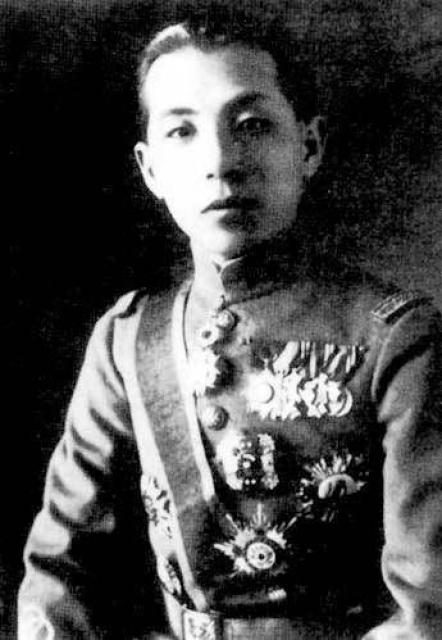
Shueliang Chang
 China
China- Biography of Zhang Xueliang
- Early Life and Military Career
- Political Involvement and Civil War
- The Xi'an Incident and Later Life
Biography of Zhang Xueliang
Zhang Xueliang, born on June 3, 1901, in Fengtian Province, was the son of Zhang Zuolin, a military ruler of Manchuria in 1917-1928. He is known as one of the leading figures of the Kuomintang China in the 1930s. His father, also known as the "Old Marshal," was a powerful warlord who aspired to leadership over all of China. In contrast, Zhang Xueliang wanted to see a unified China and was willing to take secondary roles to achieve it.
Early Life and Military Career
Zhang Xueliang received a comprehensive education, thanks to his father's efforts, despite his own illiteracy. After graduating from high school, he attended the Northeast Military Academy, one of the country's top educational institutions, where he was taught according to classical Confucian principles. As a young cadet, he traveled to Japan in 1921 to observe military maneuvers. Upon completing the academy in 1922, Zhang Xueliang was promoted to the rank of Major General and appointed as the commander of the 2nd Model Brigade. Within two years, he commanded the 3rd Army, headed the Aviation Administration, and established the first aviation school in Manchuria. He even became a skilled pilot himself.
Political Involvement and Civil War
After his father's death in 1928, Zhang Xueliang succeeded him as the strongest militarist in Manchuria. However, while his father aimed for leadership over all of China, Zhang Xueliang desired a unified country and was willing to play second fiddle. As a result of the Northern Expedition by the Kuomintang party in the summer of 1928, a significant part of China came under the control of the Nanjing government. In December of the same year, Zhang Xueliang also recognized the authority of Nanjing. The Chinese Civil War of 1925-27 was a significant moral test for him. In his advanced age, the "Young Marshal" expressed his disgust at the fact that Chinese people were killing each other.
The Xi'an Incident and Later Life
In May 1929, tensions escalated between the Nanjing government and Feng Yuxiang, who had become excessively influential. Additionally, the Japanese government, dissatisfied with Zhang Xueliang's pro-Kuomintang policies, threatened to take "the most decisive measures to ensure that the flag of the Kuomintang never flew over Manchuria." Zhang Xueliang supported Nanjing, and Feng's forces were pushed to the peripheral provinces of Chahar and Suiyuan. In July 1929, Japan officially recognized Kuomintang China. Around the same time in Beiping, Zhang Xueliang and Chiang Kai-shek held a meeting where they decided to launch an armed attack on the Northeastern Railway. Chiang Kai-shek aimed to make Zhang Xueliang completely dependent on Nanjing, increase his own prestige, and gain control over most of the railway profits. Zhang Xueliang, on the other hand, believed that capturing the Northeastern Railway would strengthen his position in the northeast, allow him to control the railway profits independently, and gain independence from Nanjing. As a result, the Conflict on the Northeastern Railway began on July 10, 1929. However, the Red Army showed greater combat effectiveness, and the conflict ended with the signing of the Khabarovsk Protocol on December 22, 1929.
In the summer of 1930, Yan Xishan, the governor of Shanxi Province, also revolted against Nanjing, and his forces occupied Beiping (renamed as Beijing again). Beijing was declared the capital of China in opposition to Nanjing. In September 1930, a government led by Yan Xishan was established in Beijing, which also included Feng Yuxiang. Thanks to Zhang Xueliang's support, Chiang Kai-shek suppressed this rebellion as well. On September 18, 1931, following the Mukden Incident, Japanese troops invaded Manchuria and occupied it. Weakened and outnumbered, Zhang Xueliang's forces retreated from Northeast China to the Jehol province. However, in March 1933, the Japanese pushed them out of Jehol as well, forcing them to retreat further to Northwest China. Zhang Xueliang resigned from active duty and went on a year-long trip to Europe for "medical treatment." His companions during this long journey included Benito Mussolini's daughter and her husband, Count Ciano, who had resigned from the post of the Italian ambassador to China.
Upon his return from Europe, Zhang Xueliang was reinstated as the commander of the Northeastern Army. In March 1936, secret negotiations began between the Communist Party of China (CPC) and Zhang Xueliang, whose Northeastern Army was located near the communist "Special District." During the negotiations, an agreement was reached between Zhang Xueliang and Zhou Enlai to establish an unofficial representation of the Red Army in Xi'an. The members wore the uniforms of the Northeastern forces and assisted Zhang Xueliang in organizing political and educational work in his army. Near the city, a school was established to train lower-level communist officers, where they were taught politics, economics, and the history of Japanese aggression in Manchuria and North China. Influenced by the growing anti-Japanese sentiments, Zhang Xueliang gradually freed himself from the conservative generals and officers of the old Northeastern Army inherited from his father, Zhang Zuolin, and began promoting young, patriotic officers and graduates of Dalian University.
Chiang Kai-shek arrived in Xi'an to prepare for the sixth punitive campaign against the Chinese Red Army. The airports in Lanzhou and Xi'an completed preparations to receive about 100 Kuomintang bombers, and a large number of aerial bombs were delivered. When Zhang Xueliang presented a program for creating a unified anti-Japanese front with the CPC, including ceasing the civil war and forming an alliance with the Soviet Union, Chiang Kai-shek allegedly replied, "I will never discuss this until the last soldier of the Chinese Red Army is annihilated, and every communist is in jail. Only then will cooperation with Russia be possible." The conclusion of the Anti-Comintern Pact between fascist Germany and militarist Japan made a significant impression on Zhang Xueliang. The rumors about Italy's imminent recognition of the puppet state of Manchukuo also left a negative impression. He began to realize the accuracy of the Chinese communists' assessments of the international situation and fascism. As a result, when Chiang Kai-shek arrived in Xi'an in December 1936 to organize the defeat of the communists, Zhang Xueliang and General Yang Hucheng arrested him. The events that followed became known as the "Xi'an Incident."
With the mediation of the communist Zhou Enlai, the crisis was eventually resolved peacefully. However, during Zhang Xueliang's last-minute decision to accompany Chiang Kai-shek and his entourage to Loyang and then Nanjing, instead of consulting with Yang Hucheng and Zhou Enlai on the timing and formalities of Chiang Kai-shek's release, he made a critical error. Chiang Kai-shek commuted the punishment for the rebel, replacing ten years of imprisonment with house arrest. However, since Zhang Xueliang was to retire from high politics permanently, the terms of his house arrest were not specified.
For the next 40 years, Zhang Xueliang remained under house arrest. Even when the Kuomintang was forced to flee from the mainland to Taiwan in 1949, Chiang Kai-shek took Zhang Xueliang with him and continued to hold him as his personal prisoner in Taipei. Even after Chiang Kai-shek's death in 1975, Zhang Xueliang's freedom of movement remained restricted. It was not until 1991 when President Lee Teng-hui allowed him to leave the island. Despite numerous offers to return to mainland China, where he was regarded as a hero, Zhang Xueliang chose to go to Honolulu, where he died from pneumonia in 2001 at the age of 101.


