Sofia Kovalevskaya
- Early Life and Education
- A Doctorate Without a University Seat
- Professor in Stockholm
- Writing and Later Years
- Legacy
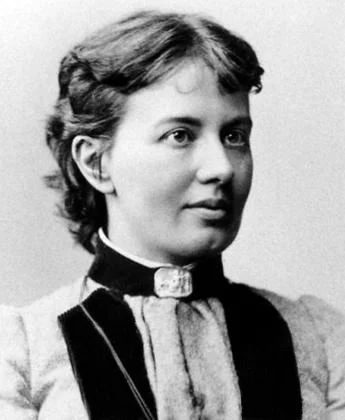
Sofia Kovalevskaya became one of the most original mathematicians of the nineteenth century at a time when universities across Europe barred women from full study. She responded by seeking out private instruction, earning a doctorate through work that impressed leading scholars, and winning a professorship in Stockholm. Her achievements in differential equations and the mechanics of rotating bodies made her a major figure in mathematics; her work as a writer and her unconventional life gave her a public identity beyond the lecture hall.
Early Life and Education
Born in Moscow in 1850, Kovalevskaya grew up on her family’s estate in the Russian Empire. Her father, Vasily Korvin-Krukovsky, was a military officer and landowner. As a young girl, she showed unusual aptitude for mathematics. One often repeated story says that a shortage of wallpaper led her family to cover the walls of her room with pages from old mathematical lecture notes, which she studied before receiving formal instruction.
Higher education in Russia was closed to women, so in 1868 she entered a so-called “fictional marriage” with the publisher and paleontologist Vladimir Kovalevsky. The arrangement allowed her to travel abroad to study. She went to Heidelberg in 1869, where women could attend lectures only with individual permission from professors. She studied mathematics and science there, then moved to Berlin in 1871. Berlin University would not admit women, but the influential mathematician Karl Weierstrass agreed to teach her privately.
A Doctorate Without a University Seat
Kovalevskaya worked independently under Weierstrass’s guidance and produced three major papers. In 1874 the University of Göttingen awarded her a doctorate in mathematics in absentia, with the highest distinction, based on her research. One of these studies established what became known as the Cauchy-Kovalevskaya theorem, concerning the existence of solutions to certain partial differential equations.
The doctorate did not immediately lead to a job. She returned to Russia, where professional posts remained out of reach, and for several years she concentrated on family life and writing. In 1878 she gave birth to her daughter, Sofia, often called Fufa. Her marriage to Vladimir had developed beyond its original practical purpose, but the couple’s domestic life was unsettled. In 1883, after financial problems and personal difficulties, Vladimir died by suicide.
Professor in Stockholm
With the support of mathematician Gösta Mittag-Leffler, Kovalevskaya began teaching at the new University of Stockholm in 1884. She learned Swedish and taught her courses in the language. Initially appointed to a temporary professorship, she became a full professor in 1889. Her appointment made her the first woman in modern times to hold a full professorship in mathematics at a European university.
In Stockholm she pursued research in analysis and mechanics and worked as an editor of the new journal Acta Mathematica. Her most celebrated mathematical work concerned the motion of a heavy rigid body rotating around a fixed point. The case she solved, now associated with the “Kovalevskaya top,” was a rare example of a complex mechanical system that could be integrated mathematically. In 1888 the French Academy of Sciences awarded her the Prix Bordin for this work, a major international honor. She was also elected a corresponding member of the Russian Academy of Sciences, though she was not given a professorship in Russia.
Writing and Later Years
Kovalevskaya was also a novelist, playwright, and essayist. Her literary work included writing about her childhood and women’s lives, and she moved easily in intellectual circles that connected science, literature, and politics. Her writing shows an interest in questions of freedom and social constraint that also shaped her own experience navigating a profession that excluded women.
She remained close to her daughter while balancing research, teaching, and travel. In January 1891, Kovalevskaya became ill after returning to Stockholm from a visit to Italy. She died there at the age of forty-one, from complications of influenza and pneumonia.
Legacy
Kovalevskaya’s career changed expectations about who could participate in advanced mathematics. Her work on partial differential equations and rigid-body motion remains part of the history of mathematical analysis and mechanics. She also became a powerful example of what talent could achieve when denied ordinary access to education: she built a scholarly career through persistence, the support of mentors, and results too substantial for academic institutions to ignore.