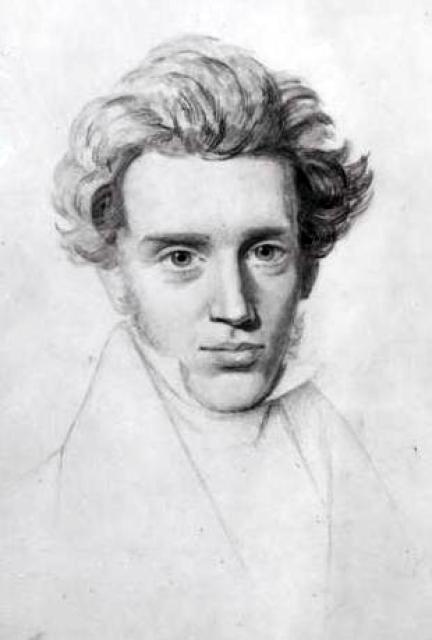
Soren Kierkegaard
 Denmark
- Early Life and Education
- Influences and Intellectual Development
- The Broken Engagement and Creative Catalyst
- Berlin and Major Publications
- Philosophical Maturity and Influence
- Controversies and Later Works
- Legacy and Impact
Early Life and Education
Søren Kierkegaard, a prominent Danish philosopher, religious thinker, and writer, was born on May 5, 1813, in Copenhagen. He received his secondary education at a classical grammar school and later attended the University of Copenhagen in 1830.
Influences and Intellectual Development
Kierkegaard's life took a significant turn following the death of his father in 1838. Two years later, he graduated with a degree in theology from the university. His master's thesis on the concept of irony was published in 1841.
The Broken Engagement and Creative Catalyst
In 1841, Kierkegaard broke off his engagement with Regine Olsen, an event that publicly ostracized him. This experience became a pivotal catalyst in his creative journey, and much of his subsequent work bears its mark.
Berlin and Major Publications
In 1841-1842, Kierkegaard spent a brief period in Berlin, attending lectures by Friedrich Schelling. In 1843, he published several important works under pseudonyms: "Either/Or," "Repetition," and "Fear and Trembling." He also released nine religious discourses in three volumes entitled "Upbuilding Discourses."
Philosophical Maturity and Influence
In 1844, Kierkegaard published "Philosophical Fragments," "The Concept of Dread," and nine more discourses. "Stages on Life's Way," published in 1845, synthesized his earlier works. In 1846, he released his magnum opus, "Concluding Unscientific Postscript," which explores the existential stages of life and emphasizes the importance of Christianity.
Controversies and Later Works
In 1846, Kierkegaard faced public criticism in a Copenhagen newspaper, leading him to write "Two Ages: The Age of Revolution and the Present Age." From 1846-1848, he published several religious texts, including "Works of Love" and "Christian Discourses." His final works included "The Sickness unto Death," "Practice in Christianity," and an autobiographical reflection entitled "Viewpoint for My Authorial Activity."
Legacy and Impact
Kierkegaard's writings have profoundly influenced European and global philosophy and literature. His ideas have inspired thinkers such as Henrik Ibsen, Miguel de Unamuno, Anton Chekhov, and Karl Barth. His influence continues to resonate in contemporary philosophy and religion.


