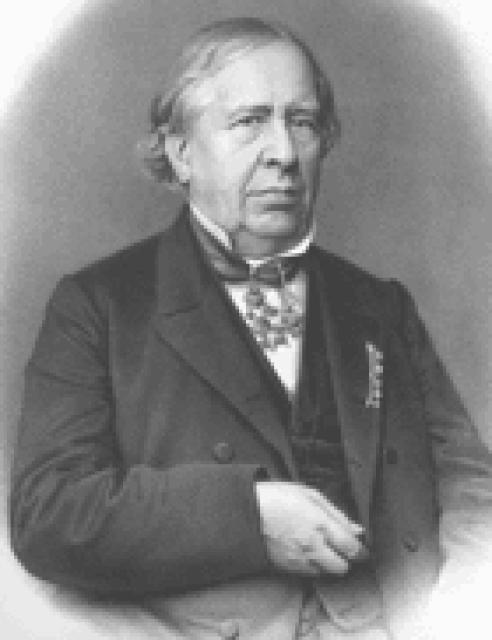
Stanislas Aignan Julien
 France
- Early Life and Education
- Early Linguistic Contributions
- Exploration of Chinese Literature and Philosophy
- Academy Honors and Administrative Roles
- Leadership and Political Views
- Literary and Scientific Contributions
- Buddhist and Sanskrit Studies
- Sanskrit Transcription Controversy
- Later Life and Legacy
Early Life and Education
Stanislas Julien, born in Orleans, France, embarked on his academic journey at the prestigious Collège de France, where he immersed himself in classical philology. In 1821, he was appointed an Extraordinary Professor of Greek Philology, marking his entry into the world of academia.
Early Linguistic Contributions
Julien's interest in classical languages extended beyond Greek. Inspired by the renowned Jean-Pierre Abel-Rémusat, he delved into the study of Chinese, mastering the literary form in an astonishing two years. His proficiency in Chinese culminated in the publication of a Latin translation of Mencius in 1824.
Exploration of Chinese Literature and Philosophy
Julien's scholarly pursuits extended to Chinese literature and philosophy. He dedicated himself to translating Chinese drama, introducing works such as "Hoei-lan-ki" and "Tchao-chi kou eul" to the French audience. His exploration of Chinese philosophy led him to translate "Le Livre des récompenses et des peines," which became the foundation of French Daology.
Academy Honors and Administrative Roles
His academic achievements were recognized in 1827 when he was appointed Keeper of the Institut de France library. In 1832, he succeeded Abel-Rémusat as Professor of Chinese at the Collège de France, and the following year, he was elected to the Académie des Inscriptions et Belles-Lettres.
Leadership and Political Views
Julien's administrative responsibilities grew with his appointment as Keeper of the Royal Library's Chinese Department in 1839. He also ascended to the position of Head of the Collège de France. As a fervent conservative, he aligned himself with the policies of Napoleon III.
Literary and Scientific Contributions
Julien's literary pursuits continued alongside his administrative duties. His interest in Chinese sericulture resulted in the publication of "Résumé des principaux traits chinois sur la culture des m?riers, et l'éducation des vers-de-soie" in 1837. His exploration of Chinese grammar culminated in "Discussions grammaticales sur certaines r?gles de position" and "pratiques d'analyse, de syntaxe, et de lexigraphie chinoise."
Buddhist and Sanskrit Studies
In the 1840s, Julien's attention shifted to early Chinese Buddhism and Sanskrit studies. He published a translation of the "Tao-té ching" and delved into the life and teachings of the Buddhist patriarch Xuanzang. His work in this field culminated in "Voyages du pelerin Hiouen-tsang."
Sanskrit Transcription Controversy
Julien's attempt to create a guide for deciphering Sanskrit names rendered in Chinese characters ("Méthode pour déchiffrer et transcrire les noms sanscrits qui se rencontrent dans les livres chinois") drew criticism from his contemporaries. The complexities of Chinese dialectal pronunciation and the varying transcription methods used in different translations rendered his method less than precise.
Later Life and Legacy
Stanislas Julien passed away in Paris, leaving behind a vast legacy in the fields of Sinology, Buddhism, and Sanskrit studies. His contributions continue to inspire scholars to this day.


