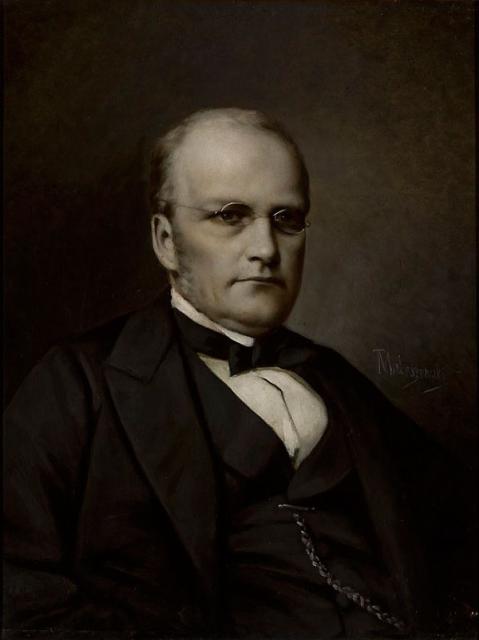
Stanislav Moniuszko
 Poland
- Early Life and Musical Education
- Early Career in Vilnius
- Composition and Innovation
- Life in Warsaw and Late Career
- Legacy
Early Life and Musical Education
Stanisław Moniuszko was born on May 5, 1819, in the village of Ubel in the Minsk region of present-day Belarus. His father, Czesław Moniuszko, was a Polish cavalry officer who had settled in the area after Napoleon's invasion of Russia. His mother, Elżbieta Madziarska, was an Armenian by descent and a descendant of the renowned Słucki sash maker Jan Madziarski.
Moniuszko's early musical education was provided by his mother. Later, he attended the Piarist School in Warsaw, where he studied piano and organ under August Freyer. From 1830 to 1837, he studied composition with Dominik Stefanowicz in Minsk, and subsequently with Carl Friedrich Rungenhagen in Berlin (1837-1840).
Early Career in Vilnius
In 1836, Moniuszko first visited Vilnius, and in 1840, after completing his education, he married Aleksandra Müller in the city. He lived in Vilnius until 1858, serving as organist at the Church of Saints John. He also taught piano and composition, and among his students was the future renowned composer César Cui.
Moniuszko's first published work, "Three Songs" on texts by Adam Mickiewicz, appeared in 1838. He composed numerous songs, which were published in collections known as "Home Songbooks." These songs laid the foundation for Polish national vocal music.
Composition and Innovation
In the early part of his career, Moniuszko wrote vaudevilles, musical comedies, and comic operas. He also composed orchestral works, including the "Fairytale" overture (1848), dedicated to Alexander Dargomyzhsky.
Moniuszko's greatest achievement was the creation of a national Polish opera. He wrote over 15 operas, the most famous of which is "Halka." First performed in a concert version in Vilnius (1848), it was staged in 1854 and revised for a four-act production in Warsaw (1858).
Life in Warsaw and Late Career
In 1858, Moniuszko moved to Warsaw, where he became a conductor at the Grand Theater (Teatr Wielki). From 1864 to 1872, he served as professor at the Warsaw Institute of Music. During a trip to Germany in 1858, he met Franz Liszt.
Moniuszko died on June 4, 1872, in Warsaw, after a brief illness. He was buried in the Powązki Cemetery in Warsaw.
Legacy
Moniuszko's contributions to Polish music are immense. He is widely regarded as the father of Polish national opera. His songs, operas, and orchestral works continue to be performed and enjoyed today.
Numerous streets, monuments, and institutions bear his name. A museum dedicated to his life and work is located in the village of Oziorny. In 2019, the year of his 200th birth anniversary, Poland celebrated his legacy with a series of concerts and events.


