Stanley Lord
 Great Britain
- Stanley Phillips Lord: Life and Legacy
- Captain of the "Californian"
- The Night of the "Titanic" Disaster
- Blamed for Neglect
- Later Life and Death
- The "Samson" Revelation
Stanley Phillips Lord: Life and Legacy
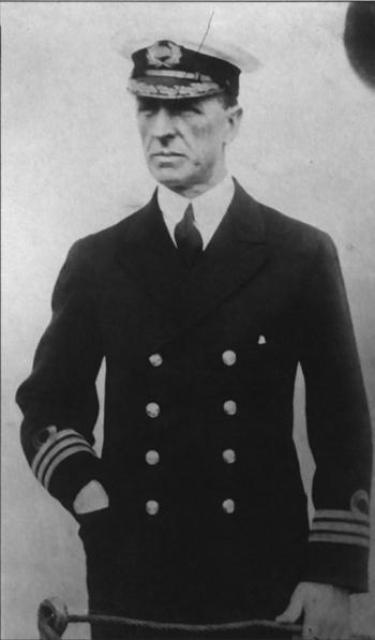
Early Life and Maritime CareerStanley Phillips Lord was born on September 13, 1877, in Bolton, Lancashire, England. At the age of 13, he embarked on his seafaring career as a cabin boy on the barque "Naiad" in March 1891. Lord subsequently received his Second Mate's Certificate and served on the barque "Lorelei." In February 1901, at the age of 23, Lord earned his Master's Certificate, followed by his Extra Master's Certificate three months later. He joined the Pacific Steam Navigation Company in 1897, which Leyland Line acquired in 1900. Lord continued his service with the new company and assumed his first command in 1906.
Captain of the "Californian"
In 1911, Lord became captain of the steamship "Californian." On the fateful night of April 14-15, 1912, the "Californian" approached a vast ice field and Lord decided to stop and wait out the night. He ordered his only radio operator, Cyril Evans, to broadcast the ice hazard to other vessels in the area. While exchanging messages with the transatlantic liner "Titanic," Evans encountered rudeness and hostility from the Titanic's radio operator, Jack Phillips. Exhausted, Evans turned off the receiver and went to bed at around 11:30 PM.
The Night of the "Titanic" Disaster
Throughout the night, officers and crew on the drifting "Californian" witnessed eight white rockets fired from "a strange ship on the horizon." These rockets were distress signals fired by the "Titanic" after it collided with an iceberg, but their significance was not recognized by the crew of the "Californian." At 1:00 AM, Lord ordered a searchlight to be shone towards the unknown vessel, but no response was received. The "Titanic" broke apart and sank at 2:20 AM. The sudden disappearance of the lights was attributed by the crew of the "Californian" to the unknown ship having resumed its course.
Blamed for Neglect
After learning of the "Titanic" disaster on the morning of April 15, 1912, Lord came under fire for allegedly failing to assist the stricken ship. A stoker named William Firth claimed to have witnessed the "Titanic" sinking without aid that fateful night. However, Firth's account was not corroborated by any other members of the "Californian" crew, and he was later found to have had a grievance against Lord. Both the U.S. and British inquiries into the disaster exonerated Lord of any wrongdoing, but his career was nonetheless ruined. He resigned from Leyland Line in August 1912.
Later Life and Death
In February 1913, thanks to the intervention of a Leyland executive who believed in his innocence, Lord secured employment with the Nitrate Producers Steamship Co., where he remained until March 1927. He resigned due to ill health. In 1957, Lord's wife, Mabel, passed away. The following year, he approached the Liverpool Marine Board seeking to clear his name. His efforts were represented by Leslie Harrison, but they were met with no success. In 1958, the film "A Night To Remember," based on the book of the same name by Walter Lord, was released. Stanley did not see the film, but he read a review in the Liverpool Echo. He was reportedly devastated by the negative portrayal of the "Californian" captain, played by Russell Napier. On January 24, 1962, Stanley Lord died of chronic renal failure at the age of 84, almost half a century after the "Titanic" disaster. His son, a single banker named Stanley Tutton Lord, continued his father's cause of exoneration, but he was unsuccessful. He rarely spoke about his father but maintained his innocence. Tutton passed away in 1994.
The "Samson" Revelation
Survivors of the "Titanic" claimed that a vessel other than the "Californian" had passed by after the ship sank and ignored their distress signals. In reality, the "Californian" had been drifting all night, so an additional vessel was implicated in the tragedy. This vessel turned out to be the "Samson," a ship engaged in illegal seal hunting in American waters. When the "Titanic" began firing rockets, the crew of the "Samson" believed they were being pursued by the U.S. Coast Guard and seeking to halt them for inspection. They fled into the night. Upon learning of the fate of the liner and their indirect responsibility for over 2,000 deaths, the crew agreed to keep their involvement a secret. They had witnessed the vilification of Stanley Lord and feared similar persecution. The captain of the "Samson," Hendrik Ness, like Lord, died in 1962. Shortly before his death, his nephew obtained the "Samson's" log and read the captain's personal diary. The nephew urged Ness to publish the sensational contents, but he steadfastly refused. The story was eventually leaked to the press. When the 84-year-old Hendrik Ness found himself under public attack, he agreed to tell his story to Norwegian reporters. Unfortunately, Stanley Lord had passed away by that time.