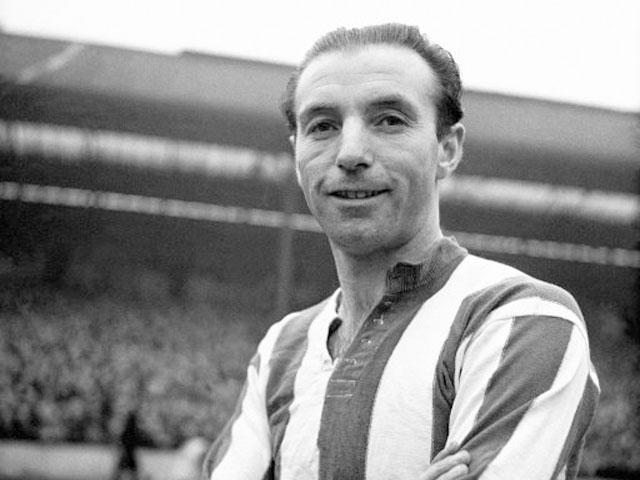
Stanley Matthews
 Great Britain
- Early Life and Professional Beginnings
- International Career and the Dark Knight's Era
- The Unforgettable 1950 World Cup and the Dawn of Global Football
- Silverware Success with Blackpool
- Golden Years and International Recognition
- Retirement, Honors, and Enduring Legacy
- Career Highlights
The Life and Legacy of Sir Stanley Matthews: A True Gentleman of the Beautiful Game
Early Life and Professional Beginnings
Stanley Matthews was born on February 1, 1915, in Hanley, near Stoke-on-Trent. His footballing journey began at the tender age of 14 when he joined Stoke City. Matthews made his professional debut for Stoke in 1932 and quickly became a regular starter on the right wing. His exceptional skill and determination earned him recognition as one of the most promising young talents in England.
International Career and the Dark Knight's Era
Matthews' international debut came in 1934 at the age of 19. However, his best years in an England shirt coincided with a difficult period for English football. England withdrew from FIFA in 1928 and did not return until 1946. As a result, Matthews was unable to display his full potential on the global stage during his prime. He played 30 of his 54 international matches during World War II, primarily against other British teams.
The Unforgettable 1950 World Cup and the Dawn of Global Football
After England's return to FIFA, Matthews finally had the opportunity to showcase his talents internationally. At the age of 35, he was part of the England squad that competed in the 1950 World Cup in Brazil. However, the tournament turned out to be a disaster for England. They suffered a shocking 1-0 defeat to the United States, which sent shockwaves through the nation. While Matthews was not directly involved in the humiliating loss, it marked a watershed moment in English football as the rest of the world began to surpass England's traditional "five-in-a-line" formation.
Silverware Success with Blackpool
Despite the disappointment of the 1950 World Cup, Matthews' career reached its peak in the early 1950s. In 1947, he transferred to Blackpool for a fee of £18,500. The move proved to be a masterstroke as Matthews inspired Blackpool to great heights. He won the Football Writers' Association Footballer of the Year award in 1948 and led Blackpool to their greatest triumph, the 1953 FA Cup Final. In a dramatic come-from-behind victory against Bolton Wanderers, Matthews orchestrated a remarkable comeback, earning the match the nickname "The Matthews Final."
Golden Years and International Recognition
Even in his 40s, Matthews continued to excel at the highest level. He became the oldest player to compete in a World Cup in 1954. In 1956, he was voted Europe's Footballer of the Year by France Football. That same year, he captained England to a 5-2 victory over Brazil at Wembley, demonstrating his extraordinary abilities even against world-class opposition.
Retirement, Honors, and Enduring Legacy
Matthews played his last match in 1965 and officially retired from football at the age of 50. His exceptional career spanned 36 years and included over 700 appearances. Despite not winning many major trophies, Matthews became a legend for his consistency, longevity, and sportsmanship. He was the first footballer to be knighted for his achievements on the pitch. After his retirement, Matthews served as a coach and manager in various countries, inspiring a new generation of players.
Career Highlights
54 matches for the England national teamFootball Writers' Association Footballer of the Year (1948)
FA Cup winner with Blackpool (1953)
Europe's Footballer of the Year (1956)
FIFA Gold Order of Merit (1992)
Knighted by Queen Elizabeth II (1965)
Inducted into the National Football Museum Hall of Fame (2002)
Inducted into the English Football Hall of Fame (2004)
Sir Stanley Matthews passed away on February 23, 2000, at the age of 85. He remains one of the most revered figures in English football history, remembered for his exceptional skill, longevity, and the grace with which he played the beautiful game.


