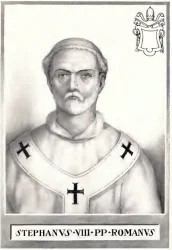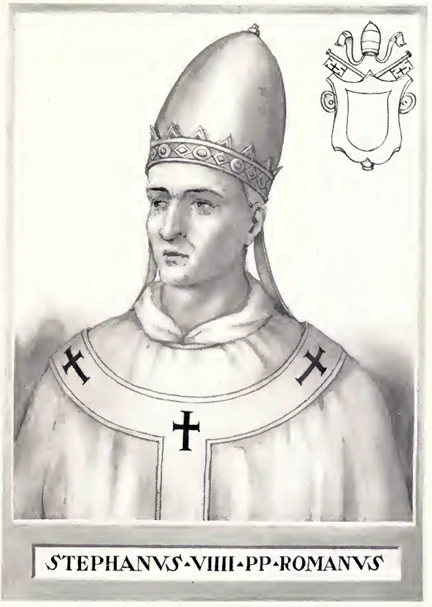
Stephen VIII
Stephen VIII served as pope from 939 until 942, during a period when powerful Roman nobles exerted strong influence over the papacy. His pontificate left few records, and much of its political story unfolded beyond Rome, in the struggles among rulers of western Europe. He is remembered as a church leader with limited freedom in the Papal States who nevertheless used his authority to support peace and royal legitimacy.
A Roman cleric becomes pope
Stephen was born in Rome, though the exact date of his birth is unknown. Before his election, he was a cardinal-priest associated with the church of Saints Silvester and Martin. He became pope on July 14, 939, succeeding Leo VII. Some historical lists call him Stephen IX because of differences in how an earlier, briefly elected Stephen is counted.
At the time, Rome was dominated by Alberic II, the powerful prince who controlled much of the city and its surrounding territory. Stephen’s pontificate was therefore constrained by a secular ruler whose family had shaped papal politics for decades. The surviving record offers little evidence of an independent political program, but it does show Stephen continuing the church’s diplomatic role in a fractured Europe.
An intervention across the Alps
Stephen supported Louis IV, the Carolingian king of West Francia, during a rebellion by powerful nobles. In 942, the pope sent a representative to France with letters recognizing Louis as king. Stephen threatened excommunication against those who continued to resist him. The rebellion subsided, and the episode demonstrated how papal recognition and spiritual penalties could still influence political disputes beyond Italy.
In Rome, Stephen also sought mediation when conflict resumed between Alberic II and Hugh of Provence, king of Italy. He turned to Odo of Cluny, the influential abbot, to help negotiate peace. The effort reflects a recurring challenge of the era: the pope was a religious authority with diplomatic reach, yet his ability to control the Papal States depended heavily on the political balance in Rome.
A brief and sparsely recorded pontificate
Stephen’s papacy lasted just over three years. He granted privileges to monasteries in Italy and France, and the Cluniac reform movement continued during his time in office. He died in October 942 and was succeeded by Marinus II.
Because the sources preserve so little about Stephen’s personal life or broader policies, his legacy is modest. His pontificate nonetheless illustrates how the medieval papacy operated amid competing powers. Stephen’s interventions in France and Italy show a pope using religious authority to shape political outcomes, even while Rome itself remained under the control of a dominant local ruler.