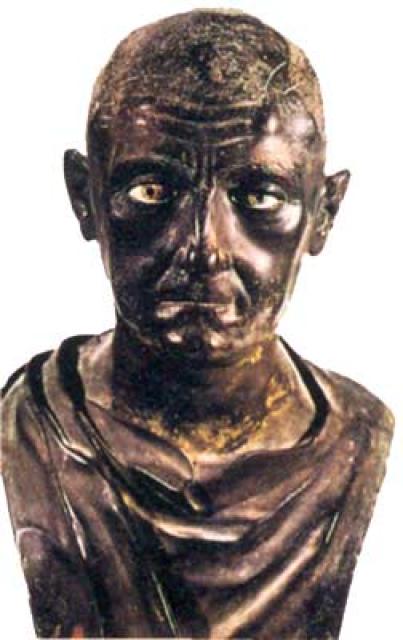
Stsipion
 Italy
Italy- Biography of Scipio Africanus the Elder
- Early Life and Military Career in Spain
- Political Career and Legacy
Biography of Scipio Africanus the Elder
Scipio, Publius Cornelius Scipio Africanus the Elder (Publius Cornelius Scipio Africanus Major) (c. 235 – c. 183 BC), was a Roman military commander and politician during the Second Punic War. He fought as a military tribune in the Battle of Cannae (216), where the Romans were defeated by Hannibal. In 207, he defeated the Carthaginian commander Hasdrubal and gradually conquered a large part of Spain for Rome. In 205, he became consul and displayed diplomatic skills, preparing for an invasion of Africa. He defeated Hannibal's army at the Battle of Zama (202) and negotiated a favorable peace treaty for Rome. Upon his return to Rome, Scipio was welcomed with triumph and given the title "Africanus". He played a prominent role in the political life of Rome after the defeat of the Carthaginian army. In 199, he became censor and princeps senatus, and served as consul in 194.
Early Life and Military Career in Spain
Publius Cornelius Scipio Africanus the Elder (237-183 BC) was a Roman military commander and politician. In 218, he participated in the battles at Ticinus and Trebia. According to legend, Scipio saved his father, Publius Cornelius Scipio, during one of the battles. After his father's death in 212, Scipio put forward his candidacy for the position of Roman commander in Spain. In 209, he landed at the mouth of the Ebro River with a 30,000-strong army and launched a surprise attack on the Carthaginian stronghold of New Carthage. The city was plundered, and prominent prisoners and Spanish hostages were taken. Scipio released the hostages without ransom, gaining the support of many Spanish tribes. In 208, Scipio defeated the Carthaginian commander Hasdrubal at the Battle of Baecula. Hasdrubal then left Spain and went to Italy to assist his brother Hannibal. In 207, Scipio's lieutenant, Marcus Junius Silanus, defeated the Carthaginian army commanded by Mago, while Scipio himself operated in Farther Spain near the Betis River. Scipio achieved another decisive victory over the Carthaginians at the Battle of Ilipa in 206, securing control over Spain. In the same year, Scipio returned to Rome and was elected consul for 205. Immediately after his election, he went to Sicily to prepare his army for the crossing to Africa. In 204, a 30,000-strong Roman army under Scipio's command landed in Africa near Utica. The following year, Scipio defeated two Carthaginian-Numidian armies at the battles of Utica and the Bagradas River. In the decisive Battle of Zama on October 12, 202 BC, he defeated Hannibal, who had returned from Italy, and forced the Carthaginians to seek peace. Scipio earned the nickname Africanus and entered Rome in triumph.
Political Career and Legacy
For the next 10 years, Scipio Africanus the Elder remained the most significant figure in Rome, serving as princeps senatus and shaping the policy of the Roman state. In 198, he was elected censor, and in 194, he served as consul for a second time. In 193, as part of a Senate commission, he traveled to Africa to resolve the dispute between the Carthaginians and the Numidian king Masinissa. In 190, Scipio Africanus served as a legate to his brother Lucius, who was elected consul for the war against the Syrian king Antiochus III. Scipio made significant contributions to the victory, although he did not participate in the decisive battle at Magnesia due to illness. Upon his return to Rome, political opponents of the Scipio family launched a campaign to discredit them. Lucius Scipio, who received the nickname Asiaticus for his victory over Antiochus III, was brought to trial for embezzlement and found guilty. In 185, Scipio Africanus was accused of receiving a large bribe from Antiochus III. Rather than face trial, he chose voluntary exile in Liternum, where he died in 183. Titus Livius described Scipio Africanus the Elder as a worthy man worthy of remembrance: "He is more famous for his military achievements than any other deeds in peacetime. The first half of his life was more glorious than the second because he spent his youth in wars, and with old age, the glory of his exploits faded, and food for the mind was not presented. What did his second consulship mean compared to his first, even if we add his censorship? What did serving as a legate in Asia mean, which was useless due to illness and marred by the unfortunate incident with his son? And after returning, he faced the choice of either appearing in court or, by avoiding it, leaving his homeland altogether? But the main glory belongs to him alone as the finisher of the Second Punic War, the most significant and dangerous of all that the Romans waged."


