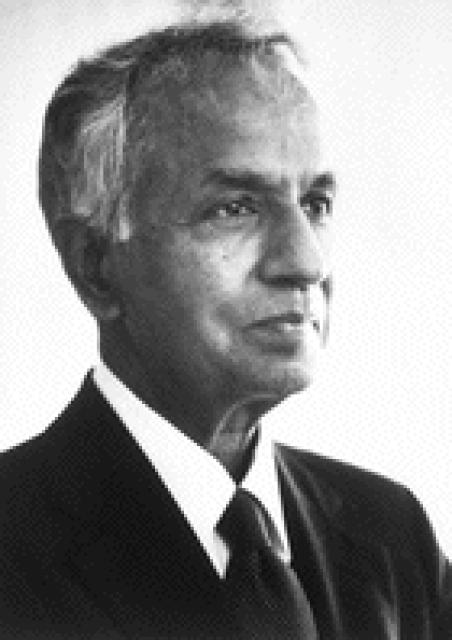
Subrahmanyan Chandrasekhar
 USA
USABiography of Subrahmanyan Chandrasekhar
Subrahmanyan Chandrasekhar was an American astrophysicist and theoretical physicist who won the Nobel Prize in Physics in 1983. He was born in Lahore and was of Tamil descent. Chandrasekhar was the nephew of renowned physicist C. V. Raman. He completed his education at the University of Madras in 1930 before continuing his studies at Trinity College, Cambridge University on a scholarship from the Government of India. His scientific supervisor at Cambridge was Ralph H. Fowler. On the advice of Paul Dirac, who temporarily replaced Fowler as his supervisor, Chandrasekhar spent a year at the Institute for Theoretical Physics in Copenhagen, where he interacted with Niels Bohr.
Afterwards, Chandrasekhar worked at the University of Cambridge from 1933 to 1937 and then at the University of Chicago in the United States from 1937 onwards. He contributed to the Manhattan Project during World War II. From 1952 to 1971, he served as the editor-in-chief of the Astrophysical Journal. His major work focused on hydrodynamics, the theory of stellar evolution and internal structure, stellar atmospheres, stellar dynamics, black hole theory, and stochastic processes.
In 1931 and 1932, Chandrasekhar published his first papers on the structure of white dwarfs. Based on the analysis of the conditions for mechanical equilibrium, he proved the existence of a maximum mass for white dwarfs, now known as the "Chandrasekhar limit." Stars whose mass exceeds the Chandrasekhar limit bypass the white dwarf stage, continue to collapse, and shed their gaseous envelope to form a neutron star. He later developed a comprehensive theory of the evolution and internal structure of massive stars.
In 1942, together with Mario Schoenberg, Chandrasekhar determined the limit for the isothermal core of a star, beyond which thermonuclear reactions start to occur in a spherical shell outside the core. This limit is now known as the "Schoenberg-Chandrasekhar limit" and formed the basis for models of red giants. He analyzed radiative transfer processes in stellar atmospheres and proposed several methods for solving the equations used to describe these processes. Using classical mechanics, he developed the theory of stellar dynamics and created a mathematical framework for the theory of black holes, using it to test the stability of these objects.
Chandrasekhar also studied hydrodynamics, including convection processes in the presence of a magnetic field. He introduced the virial method for solving hydrodynamics problems and used it to analyze the equilibrium and stability of rotating gravitating fluids. In honor of his contributions to astrophysics, the orbital observatory "Chandra" was named after him.
Throughout his career, Chandrasekhar received numerous awards and honors, including the Henry Norris Russell Lectureship (1949), Catherine Wolfe Bruce Gold Medal (1952), Gold Medal of the Royal Astronomical Society (1953), B. B. Rumford Medal (1957), Royal Medal (1962), National Medal of Science (1966), G. Draper Medal (1971), and the Nobel Prize in Physics (1983).


