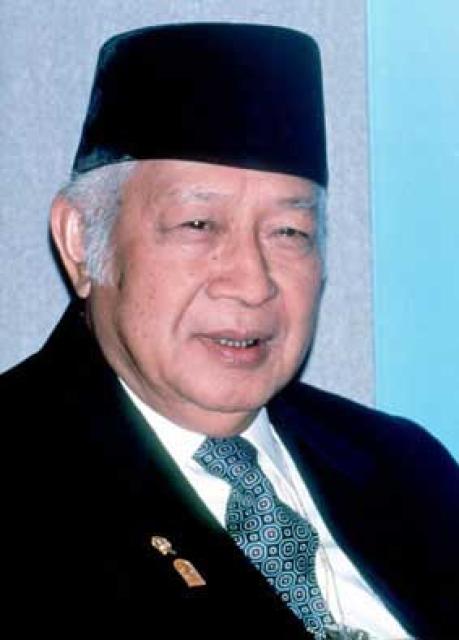
Suharto
 Indonesia
- Biography of Suharto
- Rise to Power
- The 1965 Coup Attempt
- Presidency
- Domestic and International Policies
- Downfall
Biography of Suharto
Suharto (1921 - 2008) was an Indonesian military and political figure. He was born on June 8, 1921, to a family of a minor official in the Sultanate of Yogyakarta, Central Java. Initially, he worked as a clerk in a bank before joining the Dutch colonial army in 1940, where he attained the rank of sergeant. During the Japanese occupation from 1943 to 1945, he became the commander of a company.
Rise to Power
During the war for independence from Dutch rule (1945-1949), Suharto commanded a battalion. In the late 1950s, he became a division commander, then a brigade commander in 1960. Two years later, he was promoted to the rank of major general. In the final years of President Sukarno's rule (1963-1965), Suharto led the Strategic Command of the Indonesian Army.
The 1965 Coup Attempt
During the unsuccessful coup attempt by leftist forces on September 30, 1965, Suharto was the highest-ranking army officer who survived or was not captured by the rebels. The responsibility for the coup attempt was placed on the Indonesian Communist Party with the support of President Sukarno. In the following six months, with Suharto's approval, between half a million and a million Indonesians suspected of having ties to the communists were removed from their positions or killed.
Presidency
Taking advantage of anti-communist student demonstrations, Suharto assumed leadership of the government in March 1966. He became the acting president in March 1967 and was elected president in March 1968. He was re-elected in 1973, 1978, 1983, 1988, and 1993. Suharto's ruling party, Golkar, consistently won the majority of votes in parliamentary and local elections. Under his rule, Indonesia effectively became an authoritarian regime with military dominance in all aspects of society.
Domestic and International Policies
In domestic policy, Suharto welcomed foreign investments and successfully halted inflation and achieved positive shifts in the economy by the early 1970s. Indonesia rejoined the United Nations and became a founding member of the Association of Southeast Asian Nations (ASEAN) in 1967. In late 1975, Indonesian troops occupied East Timor, a former Portuguese colony that Indonesia considered its rightful province.
Downfall
Amidst a severe financial crisis that engulfed Southeast Asian countries, including Indonesia, and mass anti-government demonstrations and riots in Jakarta and other cities, Suharto was forced to step down from his position in May 1998.


