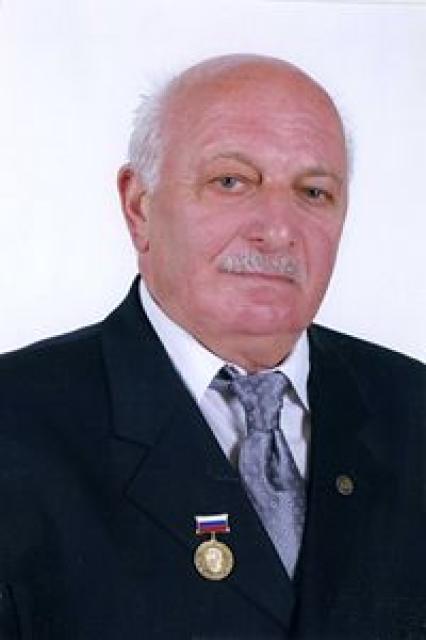
Suren Ayvazyan
 Armenia
- Biography of Suren Ayvazyan
- Interest in Armenian History
- Concept of Armenian Connection to Urartu
- Continued Publication of False Claims
Biography of Suren Ayvazyan
Suren Ayvazyan was an Armenian geologist and public figure. He was also the author of several works on linguistics and the history of Armenia, which sparked sharp criticism from experts and accusations of direct falsification of history, including by historians in Armenia itself.
Interest in Armenian History
Suren Ayvazyan became fascinated with the history of Armenia in the 1960s, aiming to prove the exceptional antiquity of the Armenian people. During a discussion with the academician Piotrovsky, who participated in excavations of the ancient Urartian city of Teishebaini, Ayvazyan engaged in a debate about the reality of the mythological ancient Armenia described by Movses Khorenatsi. According to Ayvazyan's recollection, Piotrovsky said to him, "As a geologist, you know that no natural process occurs without a trace. If, as you claim, the ancient Armenia of Movses Khorenatsi existed, then show me an archaeological object in Armenia that confirms it." Ayvazyan chose the ancient monument of Metsamor from the Bronze Age as such an object and published counterfeit drawings of coins with supposed Hayaßic (Ancient Armenian) hieroglyphs, dating them to the 19th century BCE and providing his own "translations." However, in 1968, during an examination at the numismatics department of the Historical Museum of Armenia, it was revealed that these coins were actually minted by the Atabegs of Azerbaijan from the Ildenizid dynasty in the years 1133-1225 BCE. In the same article, Ayvazyan published "Hayaßic inscriptions" that he claimed to have found on the rocks of Metsamor, which, after being examined by Professor V. A. Krachkovskaya in 1968, turned out to be signs of Kufic Arabic script from the 19th century CE. Despite the exposure of fraud, Ayvazyan's falsifications had already made their way into authoritative scientific journals, including the Czechoslovakian "New Orient" (article by B. Mkrtychan "The Mystery of Metsamor" No. 3, VI, 1967) and the journal "Anatolian Studies" (Volume XVIII, 1968), as well as the popular press of Armenia – the newspaper "Komsomolets" on November 15, 1968, and the journal "Garun" (No. 1, 1969). In these publications, Ayvazyan claims:
Concept of Armenian Connection to Urartu
Through his fraudulent activities, Suren Ayvazyan generated one of the concepts of Armenian belonging to Urartu. In addition to the aforementioned "evidence" of material culture, in 1963 he carried out a "translation" of Urartian cuneiform monuments, supposedly from ancient Armenian language. Boris Piotrovsky notes that while carrying out this work, Ayvazyan was unaware that he was duplicating the efforts of A. Mordtmann, who in the mid-19th century attempted to translate all cuneiform monuments of Mesopotamia "into Armenian" – a work long rejected by science.
Continued Publication of False Claims
Despite the exposure of his forgeries and mistakes, Suren Ayvazyan continued to actively publish the results of his "research" in the popular press. For example, he included them in his book "History of Russia. The Armenian Trace," which was published in Moscow in 1997 and 2000.
Suren Ayvazyan published a number of unexpected claims regarding the history of Rus. In particular, he asserts that the homeland of the proto-Russians, who appeared, according to his claims, in the 2nd millennium BCE, is the Armenian Highland, that the name "Tbilisi" is derived from the Russian word for "greenhouse," and that "Lisi" means "fox's." He also claims that an Armenian named Smbat Bagratuni founded Kyiv in 585 CE, that Christian cathedrals in Kyiv and Novgorod were built by Armenian architects in the 10th-11th centuries, that it was Armenians who introduced Christianity to Rus, and that the real name of Yuri Dolgorukiy was Gevorg Bagratuni. Among the premises for these claims, according to Ayvazyan, is the fact that Mount Little Ararat resembles a female breast in shape, and its other name, "Sis," sounds similar to the Russian word for the same body part. Ayvazyan also claims to have discovered (although undocumented in scientific literature) "Slavic skulls" on the Armenian Highland dating back to the 2nd millennium BCE, according to his dating.