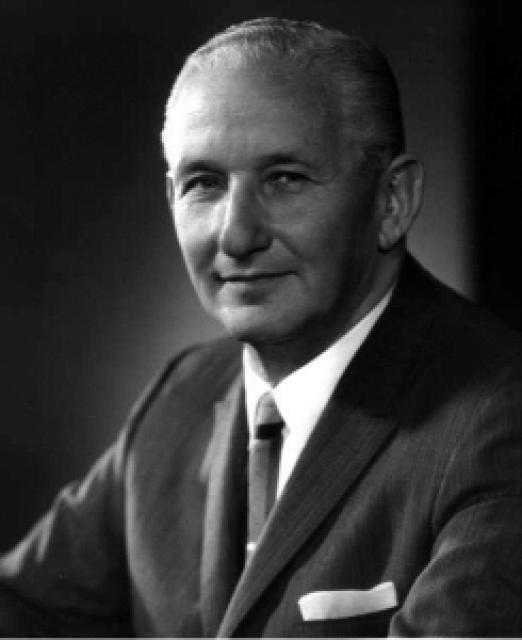
Sylvan Goldman
 USA
USABiography of Sylvan Goldman
Sylvan Nathan Goldman was an American businessman and inventor of the shopping cart that revolutionized the retail industry. Born on November 15, 1898, in Ardmore, Oklahoma, Sylvan grew up in a Jewish family. His mother, Ortens, was an immigrant from France, while his father, Michael, hailed from Latvia. Sylvan learned the ins and outs of retail trade from his father and his uncle Ortens, who owned various stores.
During World War I, Sylvan served in France, where he was involved in requisitioning food supplies. His older brother, Alfred, also served in the U.S. Army but was discharged due to health issues. Sylvan completed only eight years of education, receiving an incomplete secondary education.
After the war, in 1916, Sylvan and Alfred opened the wholesale company "Goldman Brothers Wholesale Fruits and Produce" in Breckenridge, Texas. The business thrived during the Texas oil boom, but they had to close it down after the boom ended. They then moved to California, where they worked for wholesale grocers. Initially, Sylvan and Alfred planned to start their own business in the state, but their plans changed when their uncle called them back to Oklahoma. The uncle intended to open a chain of retail grocery stores and invested all his savings, promising the nephews 75% of the future profits.
Taking advantage of their uncle's generous offer, the Goldman brothers introduced a new concept they had observed in California: the supermarket. They opened the first supermarket in Oklahoma called "Sun Grocery" on April 3, 1920, in Tulsa. Sylvan became the president, while Alfred served as the vice president of the family company. Within a year, they had opened 21 "Sun Grocery" markets in the state, and the number grew to 55 within three years.
In 1929, the "Sun Grocery" chain was sold to "Skaggs-Safeway Stores" just a few months before the stock market crash. Despite their substantial earnings, Sylvan and his brother lost a significant portion of their wealth. According to the agreement, they were prohibited from competing with "Safeway" in Tulsa. Due to this restriction, the brothers relocated to Oklahoma City, where they bought five grocery stores and formed a new company called "Standard Grocery." In 1934, they acquired the struggling grocery chain "Humpty-Dumpty." Unfortunately, Alfred passed away in 1937. In 1943, Sylvan merged the brands "Standard Grocery" and "Humpty-Dumpty" to create the unified company "Standard-Humpty Dumpty."
Sylvan introduced his innovative shopping cart in his own supermarket on June 4, 1937. With the help of a mechanic named Fred Young, Sylvan designed the first cart based on a folding wooden chair. He used a metal frame, added wheels, and two wire baskets. Another mechanic, Arthur Kostid, assisted in setting up mass production by developing an assembly line that formed and welded the wire. The patent was granted on April 9, 1940.
Initially, the invention did not receive an immediate response from customers. Men felt that using a cart would make them appear foolish and feminine, while women associated carts with baby strollers. To combat this perception, Sylvan devised a clever strategy. He hired men and women to demonstrate the convenience of the invention in supermarkets. They explained how to use the cart to other shoppers, and soon it became immensely popular, turning Sylvan into a multimillionaire.
In 1946, Orla Watson, co-founder of "Telescope Carts," added a folding rear wall to their cart, allowing it to expand and collapse with one movement. Sylvan's new cart, called the "Nest-Kart," which resembled Watson's design, was patented in 1948. Following this, "Telescope Carts" accused Sylvan of patent infringement. To reach a compromise, Sylvan agreed to give up his patent and paid one dollar for manufacturing a "counterfeit" version. In return, "Telescope Carts" granted Sylvan a license to produce the "telescopic cart." Today, the design of the modern shopping cart is based on Watson's innovations.
Apart from his contributions to the retail industry, Sylvan and his wife, Margaret, gained recognition for their philanthropic endeavors. Sylvan donated numerous works of art to various institutions in Oklahoma. He dedicated his time and money to the National Conference of Christians and Jews at the University of Oklahoma.
Sylvan received numerous awards, including the Eleanor Roosevelt Humanitarian Award in 1965. He was inducted into the Oklahoma Hall of Fame in 1971 and was awarded an honorary Doctor of Laws degree from Oklahoma City University in 1974.
In January 1983, the Oklahoma Institute of Hematology relocated to the Sylvan N. Goldman Center. The center was named in honor of Sylvan's significant financial contribution of 1.5 million dollars.
On June 7, 1931, Sylvan Goldman married Margaret "Babe" Katz from Stillwater, Oklahoma. The couple had two sons: Monte Henry Goldman and Alfred Dreyfus Goldman.