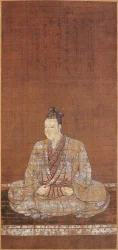
Takeda Shingen
Takeda Shingen was one of the most powerful warlords of Japan’s Sengoku period, when rival domains fought for control of a country divided by civil war. Based in Kai Province, he expanded his family’s territory into neighboring regions and built a reputation as a disciplined commander and administrator. His rivalry with Uesugi Kenshin became legendary, but Shingen’s larger ambition was to push west toward the political center of Japan.
Taking command in Kai
Born in 1521 as Takeda Katsuchiyo, he was the eldest son of Takeda Nobutora, head of the Takeda clan in Kai, now part of Yamanashi Prefecture. He later took the name Harunobu and, after entering Buddhist life, became known as Shingen. In 1541 he forced his father from power and took control of the clan.
Shingen secured Kai and expanded into Shinano, where local lords resisted Takeda authority. He used a mix of military campaigns, negotiated alliances, and careful administration to strengthen his position. The Takeda domain became known for its legal code, land surveys, military organization, and management of river flooding. Later generations remembered the embankments built along the Kamanashi River as the “Shingen embankments,” a lasting symbol of his work as a ruler.
The rivalry at Kawanakajima
The best-known military rivalry of Shingen’s career was with Uesugi Kenshin, the powerful lord of Echigo. Their armies met repeatedly in the Kawanakajima region of northern Shinano between 1553 and 1564. The encounters were part of a contest over territory and strategic routes, and the fourth battle in 1561 became especially famous for its ferocity.
Later chronicles and popular art embellished the conflict with dramatic scenes, including a story that Kenshin rode directly into Shingen’s command post and struck at him, only for Shingen to defend himself with a war fan. The episode captures the force of the legend, but its details are not securely established as literal history. The real campaigns were shaped by shifting alliances, logistics, and the struggle to control the borderlands between their domains.
A challenge to the rising powers
Shingen’s influence reached beyond the rivalry with Kenshin. He allied at different times with neighboring houses, including the Hōjō, and eventually turned against the Imagawa in Suruga. As Oda Nobunaga and Tokugawa Ieyasu grew stronger, Shingen emerged as one of their most formidable opponents.
In 1572 he launched a westward campaign and won a major victory over Ieyasu at Mikatagahara. The defeat shook Tokugawa’s forces and showed that Shingen remained a serious threat to the emerging coalition around Nobunaga. But the campaign was cut short. Shingen fell ill and died in 1573, before he could reach Kyoto. His son Takeda Katsuyori inherited the clan and its military challenge.
Legacy
Remembered as the “Tiger of Kai,” Shingen became an enduring figure in Japanese popular culture and military history. His reputation rests on more than battlefield skill: he built a powerful domain through legal administration, infrastructure, and strategic alliances. The story of his confrontations with Kenshin continues to fascinate, while his campaigns against Ieyasu and Nobunaga place him among the key figures in the turbulent struggle that preceded Japan’s eventual unification.