Tangum Vangom
 China
China- Tangun: Legendary Father of the Korean Nation
- Birth of Humanity
- Tangun's Reign
- Chronology and Debate
- Tangun as a National Symbol
- Cultural and Historical Impact
- Tangun and National Identity
Tangun: Legendary Father of the Korean Nation
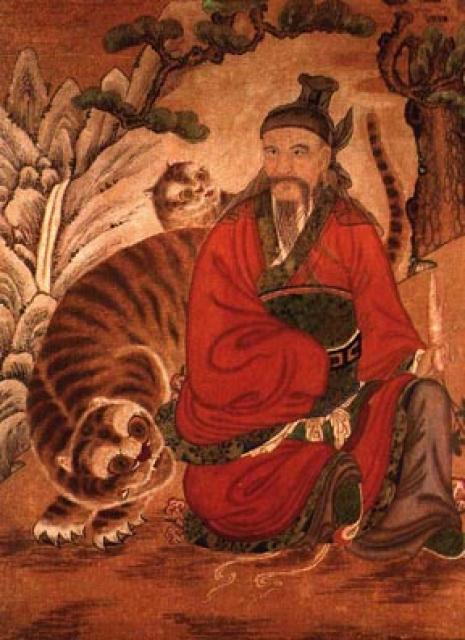
Genealogy of a Divine LegacyLegend has it that Tangun's lineage traces back to Hwanin, the celestial king. Hwanin's son, Hwanung, was destined to reside among humans on Earth. Hwanung descended with three thousand followers to Mount Paektu, where he established the divine city of Shinshi.
Birth of Humanity
In a cave, a tiger and a female bear pleaded with Hwanung for human form. He gave them twenty cloves of garlic and a stalk of mugwort, instructing them to avoid sunlight for a hundred days. The tiger failed the test, but the bear persevered, transforming into a woman named Ungnyeo. She prayed beneath the sacred Sindansu tree, beseeching Hwanung for a husband.
Tangun's Reign
Hwanung made Ungnyeo his wife, and they bore a son, Tangun Wanggeom. Tangun founded Pyongyang as the capital of his kingdom, named Chosun. He later moved the capital to Asadal on Mount Baekaksan. After a reign of 1,500 years, Tangun established Asadal as his permanent capital and became the spirit of the mountains.
Chronology and Debate
According to the "Samguk Yusa," Tangun's reign began in 2333 BCE, during the reign of the Chinese emperor Yao. Other sources provide different dates, but all agree that his reign coincided with Yao's rule (2357-2256 BCE). His lifespan is disputed, with sources claiming either 1908 or 1048 years.
Tangun as a National Symbol
Until 1961, South Korea used the Tangi calendar, starting from 2333 BCE. The legend of Tangun first appeared in the 13th-century "Samguk Yusa" and remains the most popular and well-researched version.
Cultural and Historical Impact
The myth of Tangun embodies both Buddhist and shamanistic elements common to Northeast Asian cultures. The bear motif is prevalent in foundation myths from Manchuria and the Russian Far East. North Korea announced the discovery of Tangun's mausoleum in the 1990s, but Western scholars remain skeptical due to the lack of independent verification.
Tangun and National Identity
During the Mongolian conquests, the legend of Tangun played a crucial role in national unity. Kosindo, a branch of Korean shamanism, revered Tangun as a deity. In the late 19th and early 20th centuries, the Taechonggyo movement emerged as a successor to Kosindo, fostering Korean nationalism against Japanese rule. Despite Japanese suppression, Taechonggyo continues to have followers today.