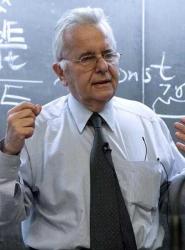
Theodore Maiman
 USA
Theodore Harold “Ted” Maiman was an American physicist and engineer who built the first working laser. On May 16, 1960, his compact ruby device produced a pulse of coherent red light at Hughes Research Laboratories in California, turning a theoretical possibility into a functioning technology with far-reaching uses.
Early life and education
Maiman was born in Los Angeles on July 11, 1927, and grew up in Denver. His father, an electrical engineer and inventor, introduced him to electronics. As a teenager, Maiman repaired radios and electrical appliances to help pay for college. He later served in the U.S. Navy.
He studied engineering physics at the University of Colorado, earning a bachelor’s degree in 1949. He continued at Stanford University, where he received a master’s degree in electrical engineering in 1951 and a doctorate in physics in 1955.
The first working laser
Maiman joined Hughes Research Laboratories in 1956 and first worked on masers, which amplify microwaves. When he turned to the challenge of producing a laser, many researchers were pursuing larger and more expensive approaches. Maiman reexamined measurements suggesting that ruby could not work and concluded that the material might be suitable after all.
He designed a device around a synthetic ruby rod surrounded by a flash lamp. The lamp’s brief, intense bursts excited the ruby, which emitted pulses of concentrated red light. The device was small and relatively inexpensive, and it worked on the first try. Maiman and his team demonstrated it on May 16, 1960. The first laser was not a continuous beam, but its success opened a new field.
Career and recognition
Maiman left Hughes the following year and founded Korad Corporation in 1962 to develop and manufacture lasers. After selling Korad to Union Carbide, he established Maiman Associates and later worked at aerospace company TRW, where he helped guide technology development and new ventures.
His invention earned recognition across science and engineering. He received the Wolf Prize in Physics in 1983 and the Japan Prize in 1987, and was inducted into the National Inventors Hall of Fame in 1984. He was elected to both the National Academy of Sciences and the National Academy of Engineering. Although nominated twice, he never received a Nobel Prize.
Legacy
Lasers now serve in fields ranging from medicine and manufacturing to communications and scientific research. Maiman’s ruby laser was a turning point in their development, and its elegant design remains a landmark example of how precise experimental insight can transform an idea into a practical device. He died in Vancouver, British Columbia, on May 5, 2007, at age 79.