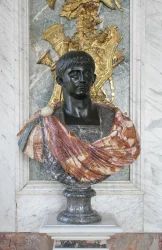
Theodosius I
Theodosius I inherited a Roman Empire shaken by military defeat and conflict over Christian belief. In the eastern provinces, the emperor known to later generations as Theodosius the Great worked to restore imperial authority, negotiate with the Goths, and establish Nicene Christianity as the favored doctrine of the state. His rule reshaped both church and empire, but it also included brutal violence and hard political choices.
From Spain to the Imperial Throne
Flavius Theodosius was born in Hispania, in the Roman West, around 347. His father was a prominent general, and Theodosius himself pursued a military career. After a period away from public life, he was recalled by the western emperor Gratian following the catastrophic Roman defeat at Adrianople in 378, where the eastern emperor Valens was killed fighting the Goths. In January 379, Gratian elevated Theodosius to the rank of Augustus and assigned him the eastern half of the empire.
Theodosius faced a crisis that could not be solved by a single battlefield victory. The Goths had entered Roman territory and remained a powerful force. After years of conflict, the emperor negotiated a settlement in 382 that allowed Gothic groups to live within the empire under their own leaders while supplying soldiers to Rome. The arrangement helped stabilize the frontier, though it also reflected the empire’s dependence on peoples it had recently fought.
Faith and Imperial Power
Theodosius’s religious policies transformed the Roman world. In 380, he and his co-emperors issued the Edict of Thessalonica, which required the people of Constantinople to follow the Nicene Christian faith associated with the bishops of Rome and Alexandria. The Council of Constantinople in 381 reaffirmed this creed. Over the next decade, imperial laws increasingly favored Nicene Christianity and restricted public pagan sacrifice. The change was gradual, but the emperor’s backing helped make one form of Christianity dominant in the empire.
His religious rule was also shaped by a famous confrontation with Ambrose, bishop of Milan. In 390, after a riot in Thessalonica and the killing of a Roman commander, the emperor’s forces carried out a massacre of civilians. Accounts of the event were written later and differ in their details, but it became a lasting stain on Theodosius’s reputation. Ambrose challenged the emperor to show repentance before returning to church. Later Christian writers described Theodosius submitting to penance, turning the episode into a celebrated example of a ruler answerable to moral authority.
Reunifying the Empire and Its Aftermath
Theodosius later faced civil war in the West. After the death of Valentinian II, the usurper Eugenius claimed power. Theodosius defeated him at the Battle of the Frigidus in 394 and briefly became the sole ruler of the Roman Empire. The victory strengthened his authority but came at enormous cost and left the empire dependent on the succession of his young sons.
Theodosius died at Milan on January 17, 395. His sons Arcadius and Honorius inherited authority in the East and West, respectively, continuing the administrative division that had long shaped Roman government. Later history remembered Theodosius as “the Great,” especially for making Nicene Christianity central to imperial life. His reign, however, was more complicated than that title suggests: he was a restorer of Roman power, a religious lawmaker, a negotiator with the Goths, and an emperor whose orders could unleash devastating violence.