 |
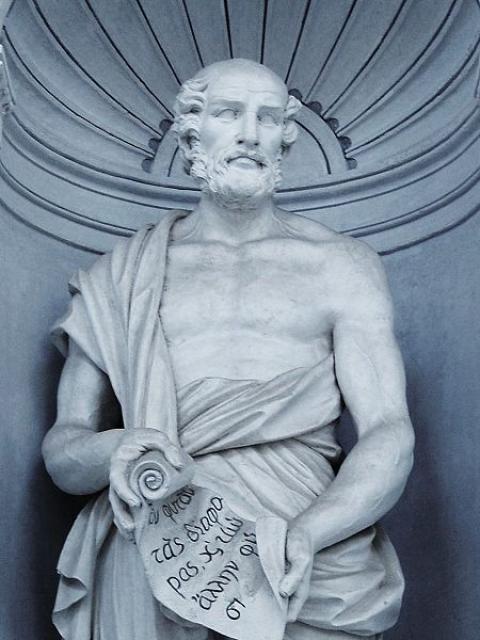
TheophrastusAncient Greek philosopher, natural scientist, music theorist.
Country:
 Greece Greece |
Content:
Biography of Theophrastus
Theophrastus was an ancient Greek philosopher, naturalist, and theorist of music. He was a versatile scholar and, alongside Aristotle, is considered one of the founders of botany and plant geography. He studied in Athens under Plato, and later Aristotle, becoming his closest companion and successor as head of the Peripatetic school in 323 BCE.
Contributions to Botany
Theophrastus wrote two books on plants: "The History of Plants" and "The Causes of Plants." These works laid the foundations of plant classification and physiology, describing approximately 500 species of plants. Despite not adhering to any specific methodology in his botanical works, Theophrastus introduced ideas that were free from the prejudices of his time. He believed that nature acted according to its own designs, rather than solely for the benefit of humans. He addressed key problems in scientific plant physiology, such as the differences between plants and animals, the functions of roots, stems, leaves, and fruits, the causes of plant diseases, and the influence of temperature, moisture, soil, and climate on the plant world.
Ethical Characters
One of Theophrastus' most famous works is "Ethical Characters," a collection of 30 essays depicting various human types. Each character is vividly portrayed through situations in which their traits are displayed. For example, the miser silently leaves a gathering when donations are being collected, and as a ship's captain, he sleeps on the helmsman's mattress. Theophrastus' "Ethical Characters" influenced the development of literary portraits and became an integral part of European novels.
The Nature of Music
In a fragment from his two-volume treatise "On Music," Theophrastus engages in a critique of the Pythagorean and Platonic view that music is a manifestation of numbers. He also dismisses the significance of the harmonic thesis, which considers melody as a sequence of discrete intervals. According to Theophrastus, the essence of music lies in the "movement of the soul, which is relieved of evil through experience." He argues that without this movement, music would cease to exist. Unfortunately, only a valuable fragment of this work has survived.
Other Works
Theophrastus is also credited with a treatise called "On Style" or "On Diction," which, according to M.L. Gasparov, holds significant importance in the entire ancient theory of rhetoric. Although this work has been lost, it is mentioned by Dionysius of Halicarnassus and Demetrius Phalereus, among others.
Overall, Theophrastus was a groundbreaking philosopher and naturalist who made significant contributions to the fields of botany, ethics, and music theory. His works continue to be studied and appreciated for their valuable insights into the natural world and human behavior.



