Thomas Carew
 Great Britain
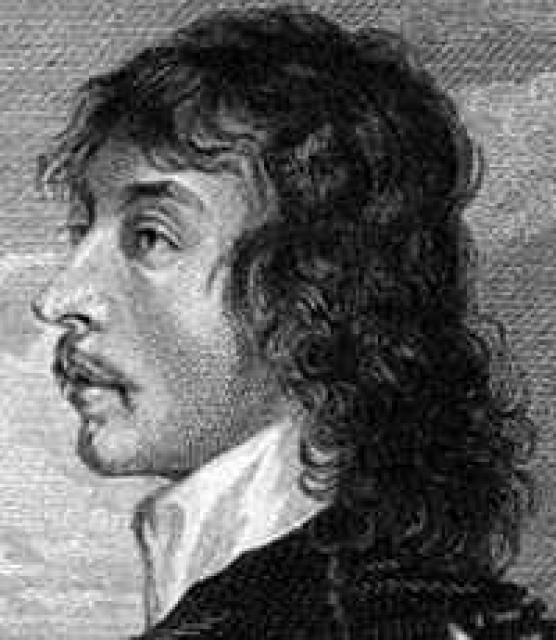
Thomas Carew (born between June 1594 and June 1595; died March 1640) was an English poet and courtier associated with the literary circle of King Charles I. Known for elegant lyric verse that joined wit with sensuality, he is usually grouped with the Cavalier poets. His work also engaged directly with the poetry of John Donne and Ben Jonson, whose styles shaped his own.
Early life and education
Carew was born probably at West Wickham in Kent, the son of Sir Matthew Carew, a legal official, and Alice Ingpenny. He matriculated at Merton College, Oxford, in 1608, aged about thirteen, and later studied at Cambridge and the Middle Temple in London. Although his family expected him to pursue law, he moved instead into diplomatic and court service.
From 1613 he worked as a secretary to Sir Dudley Carleton, an English diplomat. He accompanied Carleton to Venice and later to The Hague. After that employment ended, Carew joined the diplomatic household of Sir Edward Herbert, later Lord Herbert of Cherbury, and traveled to Paris in 1619. These years abroad introduced him to European court culture and gave him experience that helped prepare him for a position in the royal household.
Court life and literary circle
Carew established himself at the court of Charles I during the 1620s. He held positions in the royal household, including that of sewer in ordinary, an officer responsible for serving at the royal table, and became known for his wit and social ease. Court life provided both the audience and the subjects for his poetry: love, beauty, desire, wit and the rituals of aristocratic society.
He moved among leading writers of the period, including Ben Jonson and John Donne. Carew admired both, but was not merely an imitator. His verse combines the polished musicality associated with Jonson with the concentrated argument and intellectual turns associated with Donne.
Poetry and major works
Many of Carew’s poems circulated in manuscript among court readers during his lifetime. His lyric “Ask Me No More Where Jove Bestows” is among his best-known works, while “A Rapture” displays his frank treatment of erotic desire. The tone of his poems ranges from graceful courtship to witty, sometimes provocative reflections on the body and on the pleasures of love.
Carew’s 1633 elegy on Donne’s death is one of his most important critical poems. It praises Donne as a poet who transformed English verse and considers what his achievement meant for later writers. Carew also wrote verses defending Jonson’s comedy *The New Inn* after it was poorly received.
His masque *Coelum Britannicum*, with music by Henry Lawes and stage design by Inigo Jones, was performed at Whitehall in 1634 before the king and court. Like other court masques, it combined poetry, music, dance and spectacle, celebrating the monarchy and its ideals.
Later years and legacy
Carew died in March 1640, apparently after a period of illness. The first collected edition of his poems appeared shortly after his death, also in 1640, bringing together lyrics that had previously circulated mainly in manuscript.
His reputation rests on the precision and musicality of his short poems and on the way he helped define the courtly lyric tradition of the Caroline era. Though often grouped alongside other Cavalier poets, Carew’s work is distinctive for its combination of sensual subjects, formal control and thoughtful engagement with the writers who came before him.