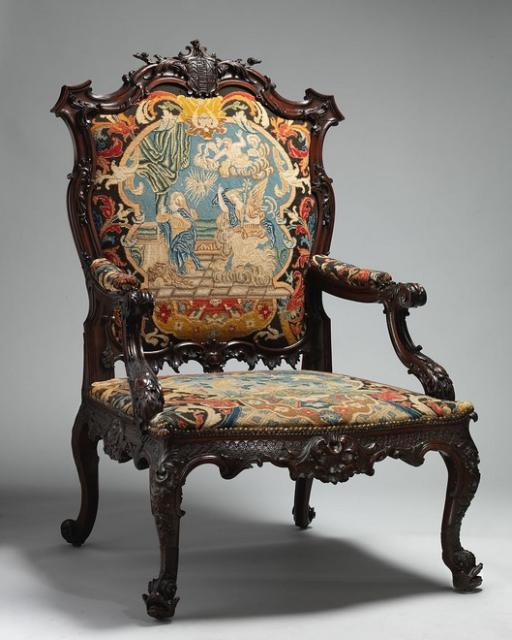
Thomas Chippendeil
 Great Britain
- Biography of Thomas Chippendale
- Establishing His Workshop and Publication
- Collaboration with James Rannie
- Influence and Legacy
- Thomas Chippendale's Successor
Biography of Thomas Chippendale
Thomas Chippendale was an English furniture maker and master of the furniture arts. He was born on June 5, 1718, in Otley, Yorkshire, into a family of cabinetmakers. Chippendale is considered one of the finest furniture design masters of the 18th century.
Establishing His Workshop and Publication
In 1749, Chippendale opened his own workshop in London. He gained widespread recognition and prosperity when he published a luxurious catalog called "The Gentleman and Cabinet-Maker's Director" in 1754. The catalog was reissued in 1759 and 1762 and featured furniture designs incorporating Gothic, Chinese, and Rococo motifs. This album of furniture sketches quickly brought fame and success to its creator.
Collaboration with James Rannie
Chippendale worked closely with James Rannie until Rannie's death in 1766. The furniture created from Chippendale's designs was known for its durability, longevity, and comfort. Chippendale's chairs and armchairs were particularly renowned for their carved-through, "ribbon" backrests. His preferred material was unpainted dark polished mahogany, and he was a skilled carver who loved to embellish his furniture with intricate ornamentation.
Influence and Legacy
Chippendale also crafted furniture for the brothers Adam, talented masters with refined taste. He introduced the French style to English furniture and his interpretation of Chinese motifs continues to inspire imitators. Chippendale's style had a profound impact on furniture design in America and partially in Germany.
Thomas Chippendale's Successor
Thomas Chippendale passed away in London on November 13, 1779. One of his eleven children, also named Thomas (1749-1829), succeeded his father and successfully continued his legacy for over forty years. He worked alongside master Thomas Haig.