Thomas Graham
 Great Britain
- Thomas Graham: A Scottish Pioneer Chemist
- Academic Career
- Scientific Contributions
- Catalysis and Inhibition
- Polybasic Acids
- Osmosis and Colloidal Chemistry
- Occlusion of Gases
- Later Life and Legacy
Thomas Graham: A Scottish Pioneer Chemist
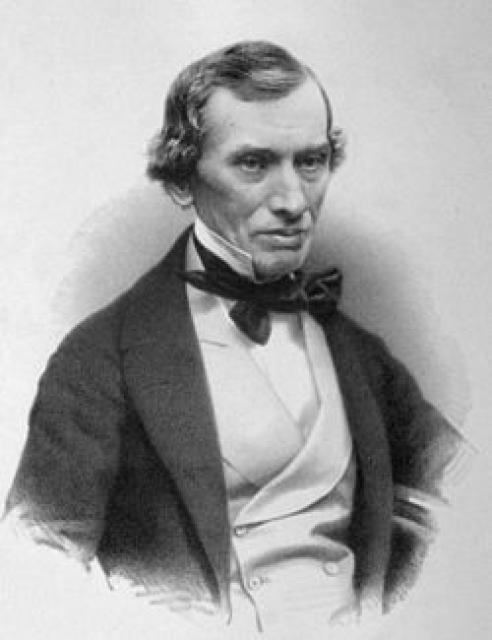
Early Life and EducationThomas Graham, born on December 20, 1805, in Glasgow, Scotland, was the son of a merchant. Initially pursuing theology at the University of Glasgow in 1819, his true passion lay elsewhere. He devoted himself to chemistry, attending lectures and pursuing extensive independent readings. In 1824, he earned his Master of Arts degree.
Academic Career
Graham served as a chemistry assistant at the University of Edinburgh for four years before returning to Glasgow in 1828. He taught chemistry and mathematics while continuing his research. In 1830, he became a professor of chemistry at Anderson's University in Glasgow, and in 1837, he assumed the chair of chemistry at University College London.
Scientific Contributions
Diffusion and Gas LawsGraham's significant contributions began with his research on gas absorption and diffusion. In 1831, he proposed the law that the rate of diffusion of gases is inversely proportional to the square root of their densities. This law, known as Graham's Law, revolutionized our understanding of gas behavior.
Catalysis and Inhibition
Graham's study of phosphorus oxidation led him to discover that certain gases, even in trace amounts, could slow down the reaction. This phenomenon, which he termed "negative catalysis," became the first documented case of what we now know as negative catalysis.
Polybasic Acids
Graham's investigation of phosphate chemistry resulted in the discovery of a new type of phosphoric acid, which he named "meta-phosphoric acid." His work laid the groundwork for the theory of polybasic acids, which challenged the hydrogen theory of acids.
Osmosis and Colloidal Chemistry
Expanding his research to liquids, Graham introduced the concept of osmosis, although the laws governing the phenomenon were not fully elucidated until later. He also recognized the distinction between crystalloids and colloids, substances that form stable solutions and crystallize, and those that form unstable solutions and tend to coagulate. This laid the foundation for the field of colloid chemistry.
Occlusion of Gases
In the late 1860s, Graham discovered the phenomenon of gas occlusion, where gases are absorbed into microscopic cavities within metals. This work marked the culmination of his illustrious career.
Later Life and Legacy
Graham passed away on September 11, 1869, in London. His pioneering contributions to chemistry, particularly in the areas of diffusion, catalysis, and colloids, have had a profound impact on the field. He is remembered as one of Scotland's most influential scientists. Graham's legacy continues to inspire and guide chemical research to this day.