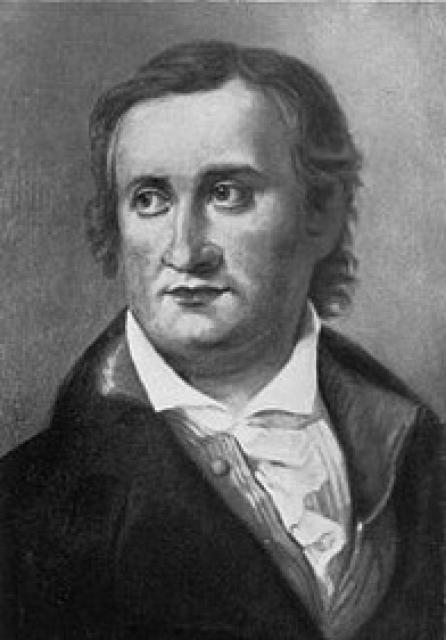
Thomas Johann Seebeck
 Germany
- Thomas Johann Seebeck: Early Life and Education
- Transition to Physics and Research
- Optical Discoveries
- Contributions to Acoustics and Thermal Science
- Pioneering Work in Electricity
- Confirmation of Brewster's Law
- Innovative Cooling Method
- Legacy and Impact
Thomas Johann Seebeck: Early Life and Education
Thomas Johann Seebeck was born on April 9, 1770, in Reval, Estonia. He pursued a medical education and practiced as a physician in Jena, Bayreuth, and Nuremberg.
Transition to Physics and Research
In 1818, Seebeck moved to Berlin and became a member of the Academy of Sciences. He shifted his focus toward physics, specializing in optics, acoustics, and thermal science.
Optical Discoveries
Seebeck made significant contributions to optics, including the discovery of chromatic polarization phenomena in uniaxial and biaxial crystals. His observations were corroborated by Bio in France and earlier by Brewster and Wollaston in 1813 and 1814, respectively.
Contributions to Acoustics and Thermal Science
In the field of acoustics, Seebeck investigated the influence of the motion of a sound-producing body on its height of tone. He also conducted research on the distribution of thermal rays in the solar spectrum.
Pioneering Work in Electricity
Seebeck's most renowned contribution lies in electricity. In 1821, he discovered thermoelectric currents and transverse magnetization. He also studied the chemical action of light and found that its effects persist for an extended period in darkness.
Confirmation of Brewster's Law
Seebeck experimentally verified Brewster's law, which relates the refractive index of a material to the angle of complete polarization.
Innovative Cooling Method
In 1834, Seebeck developed a technique for cooling substances using electricity, further expanding his legacy in the study of thermal phenomena.
Legacy and Impact
Thomas Johann Seebeck's remarkable contributions to physics earned him a place in the annals of science. His discoveries laid the foundation for future research in thermoelectricity and other fields. He passed away on December 10, 1831, in Berlin, leaving behind a lasting legacy as one of the fathers of modern physics.



