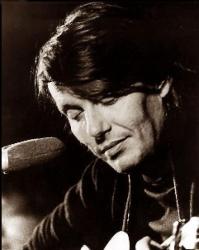
Tim Buckley
 USA
USA- The Life and Career of Tim Buckley
- Early Life and Influences
- The Beginning of a Serious Career
- Artistic Evolution and Challenges
- The Final Years and Legacy
The Life and Career of Tim Buckley
Tim Buckley, the American folk singer, will forever be remembered as a young and vibrant artist. He never grew old, as a third of his life was dedicated to music. In just nine years, he released nine albums, each one unpredictable, spontaneous, and breathtakingly beautiful. As a composer and singer, Tim Buckley explored folk, folk-rock, pop, jazz-rock, and psychedelia. He never sought the easy path and was incapable of staying in one place, constantly surprising his audience with every new musical direction. Like Miles Davis or David Bowie, he couldn't live without taking creative risks, as music for him was never about personal gain. His sense of style and expressive vocals with an impressive range served as his lifeline, helping him emerge victorious from many stylistic and emotional adventures, even if they were sometimes pyrrhic victories.
Early Life and Influences
Timothy Charles Buckley III was born on February 14, 1947, in Amsterdam, New York, on Valentine's Day. But music played a much bigger role in his life than love. His grandmother listened to records by Billie Holiday and Bessie Smith, while his mother adored Sinatra and Garland. Timoth had a deep admiration for "singing cowboys" Johnny Cash and Hank Williams. His love for country reached its peak when his family moved to Anaheim in the West. As far as he could remember, Timothy dreamt of singing. He imitated the smooth voices of Nat 'King' Cole and Johnny Mathis. But he also skillfully imitated the sound of a bus engine or the blast of a trumpet. His parents were skeptical of his interests. His father, who suffered severe wounds during World War II, was an angry and impulsive person. Timothy's appearance irritated him, and he called him a sissy and even lashed out physically. He didn't believe in his son's talent, predicting a future of failure. His mother also didn't support Timothy, often repeating that he would die young, like all poets. One of Timothy's close friends remembered that he grew up "very vulnerable and insecure, although he felt his enormous potential. He seemed like a normal teenager in school, just a bit wild, but even then he suffered from severe neurosis. Deep down, he was afraid of success. He really wanted people to love him, but he pushed away anyone who approached him."
The Beginning of a Serious Career
Tim Buckley decided to start his serious career in Los Angeles. The band Princess Ramona & The Cherokee Riders needed a guitarist, and Tim quickly realized that his soul didn't belong to country. The folk scene seemed much more appealing. To test the waters, Buckley created two parallel projects: a mainstream-oriented group called Bohemians and an esoteric acoustic ensemble called Harlequin 3 with a jazz influence. Both endeavors were supported by loyal friends he had known since his school days: bassist Jim Fielder and poet/drummer Larry Beckett. Even then, Tim knew how to surprise. After years of perfecting his vocals, he mastered them skillfully, showcasing a range of four octaves and a beautiful vibrato that he kept under control. It was a fantastic feat for an artist his age. Through mutual acquaintances, rumors about Buckley and his company reached the renowned music manager Herbie Cohen. After listening to the group perform, Cohen immediately took Tim Buckley under his wing. Initially, Cohen saw the musician primarily as a promising composer, but after hearing several demo recordings, he realized the singer's remarkable vocal talents. As a result, 19-year-old Tim Buckley signed a contract with Elektra Records and, before his 20th birthday, released his debut album, "Tim Buckley" (1966). It was a work that couldn't be called flawless, but it was considered highly promising. The focus was on ethereal melodies and mysterious, poetic lyrics. Many of the songs were co-written with Larry Beckett, a talented poet. The psychedelic direction taken by Elektra Records gave the early folk-rock sound of Buckley an appropriate touch. Guitarist Lee Underwood, keyboardist Van Dyke Parks, drummer Jerry Yester, and bassist Jim Fielder were responsible for implementing these transformations.
Artistic Evolution and Challenges
The delicate beauty of the arrangements, colored in melancholic tones, was not the kind that brought commercial success. However, for the sensitive followers of the underground scene, the first album was enough to ignite intense feelings towards the singer. The second album, "Goodbye and Hello" (1967), was even more intriguing. Both the composition of the songs and the orchestration became more ambitious, and the psychedelic influence became more pronounced, especially in the lengthy titular track. The album barely crossed the lower boundary of the pop charts, reaching the 171st position. However, the third album, "Happy Sad," released in 1969, reached the 81st position on the charts. By this time, Tim Buckley was eager to try something new, such as his long-time passion for jazz. Jazz elements permeated both the vocal parts and the arrangements, enriched with new percussion instruments such as the vibraphone and congas. The success of the album was notable, as this style of music went against market expectations. But this was only the beginning. Buckley was too obsessed with music to be concerned with what the audience expected from him. His disconnect from reality gradually turned into a chasm. As his colleagues recalled, "Tim was consumed by music 24/7. He ate, drank, and breathed music. No one would be surprised to find out that he composed melodies and chords even in his sleep."
By the end of the 1960s, folk-rock no longer held much interest for Buckley. He was truly captivated by jazz, not just its popular forms but also its more complex avant-garde varieties. His songs became more spontaneous, unpredictable in structure, and the lyrical component was reduced to a poetic skeleton. There came a point when Buckley decided to part ways with his main co-writer, Larry Beckett, to test his own poetic prowess. This task was made easier by the fact that in some compositions, he didn't use any words at all, using his voice as an additional instrument, piercing and mournful, expertly imitating a saxophone and pushing the boundaries of cacophonous dissonance. It's no wonder that his album "Lorca" (1970), named after the tragically deceased Spanish poet Federico Garcia Lorca, was received not only as a shocking departure from his established style but also as a disappointing misunderstanding. On this album, which showcased Buckley's new direction, he attempted to express the fury and tenderness of Lorca's poetry through his vocals. The result left listeners perplexed. Instead of a romantic and lyrical vocalist, they were presented with a disheveled experimenter who seemed to enjoy the opportunity to assault their ears with screeching dissonance.
To prove that he hadn't forgotten the path of soft, life-affirming pop-folk in a light jazz haze, Buckley released the album "Blue Afternoon" alongside "Lorca." Although the albums were released on different labels, they were still dependent on the attention of the audience. Fortunately, life eventually improved. Tim Buckley found great support in his new girlfriend, Judy, who soon became his wife.
The Final Years and Legacy
In 1972, when Tim Buckley finally returned to the studio, his efforts took a more peaceful and reasonable direction. The change in management and pressure from the label, which was now under new ownership, had a significant impact. However, this didn't dramatically affect Buckley's reputation. While he indulged in jazz experiments, a divide among his fans began to grow.
The first of three final releases, "Greetings from L.A." (1972), sparked some excitement among music lovers. As always, it was an extraordinary album in which Buckley once again revealed his imagination and inventiveness. For many, this album, recorded with Los Angeles session musicians and full of sexual allusions, served as the best proof of Buckley's skill and creative maturity. However, others saw it as a sign of decline, the wasted talent of a former wunderkind who couldn't fulfill his potential. The albums released in 1973 and 1974, "Sefronia" and "Look at the Fool," were also received with mixed reviews. Ultimately, people agreed that the early 1970s recordings were the least interesting in Buckley's catalog, primarily because the opinions of others began to play a too significant role in his music.
In June 1975, this tumultuous story unexpectedly came to an end. A few days after completing his farewell tour (which he didn't realize at the time), Tim Buckley took an overdose of heroin and died. For some, such an ending seemed perfectly fitting. "He had been teetering on the edge for a long time," people said about Buckley, "both in his music and in his life." However, close friends insisted that he had been drug-free in recent times and struggled immensely with the loss of an artist who, they were convinced, still had much to say.
Interestingly, two months before his death, Buckley met his 8-year-old son, Jeff Buckley, who was born when Timothy was just 19 and starting his musical career. At the time, raising a child was not part of his plans. Despite the lack of direct influence, genetics played their part. Jeff grew up to be a talented musician, a fearless composer, and a brilliant vocalist. He tragically died at the age of 30, exactly 22 years after his father's death.
For many years, Tim Buckley's name was associated with the rock underground scene. Interest in his legacy was reignited in the 1980s when Cocteau Twins released his song "Song for the Siren." In the early 1990s, two live albums, "Dream Letter" and "Live at the Troubadour 1969," reminded the world of one of the best rock vocalists of the 1960s. Jeff Buckley's death in 1997 shook the rock community, rekindling memories and prompting musicians and record labels to revisit the tragic stories of Tim and Jeff Buckley. In 2000, a compilation of Tim and Jeff Buckley's lyrics was released, and a two-day festival dedicated to the father and son's music took place in Italy. In 2001, a tribute concert to Tim Buckley was held in London, and two compilations of Tim Buckley's best tracks were released in the United States, forever immortalizing the 28-year-old Timothy Charles Buckley III.