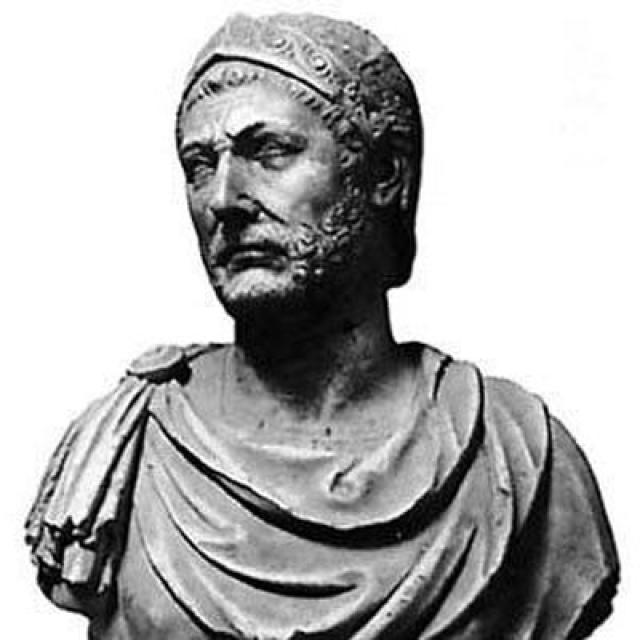
Tit Livius
 Italy
ItalyBiography of Titus Livius
Titus Livius, a Roman historian, was born in the city of Patavium (modern-day Padua) in northern Italy during a time of prosperity for the city, both economically and culturally. His childhood and youth coincided with the rapid ascent of Julius Caesar to power and the subsequent civil wars that led to the establishment of the empire under Augustus. Livius remained on the sidelines of these turbulent events, preferring the life of a scholar. At some point in his early life, Livius moved to Rome, as the city provided the necessary resources for his historical studies.
Very little is known about Livius's personal life. It is known that he supervised the education of the future emperor Claudius. His friendship with Augustus was of great importance to Livius, as Augustus admired him as a person and appreciated his book, despite its republican spirit.
Life as a Historian
In his youth, Livius wrote philosophical dialogues that have not survived to this day. Around 26 BC, he embarked on his main work, "The History of Rome," which he worked on until the end of his life, covering the period up to the death of Drusus in 9 BC. This monumental work consisted of 142 books, equivalent to 15-20 volumes of medium size by modern standards. Only about a quarter of the work survived, including Books I-X, which cover the period from the legendary arrival of Aeneas in Italy to 293 BC; Books XXI-XXX, which describe Rome's war with Hannibal; and Books XXXI-XLV, which continue the narrative of Rome's conquests until 167 BC. The content of the remaining books is known through a later summary. Livius was inclined towards romanticism, and in the preface to his history, he states that the goal of a historian is to promote morality. When Livius wrote his book, Roman society was experiencing a decline in many respects, and the historian looked back with admiration and longing for simpler times and higher virtues. According to Livius, the value of any historical study lies in its applicability to life. He urges readers to read the history of the great nation and find in it both examples and warnings. The greatness of Rome was based on strict adherence to duty, both in personal and public spheres, and all the troubles began with the loss of fidelity to established rules. The conquest of foreign lands brought wealth, and with wealth came luxury and a disregard for moral principles.
Writing Style and Legacy
Livius approached ancient Roman legends, which he rightly regarded as belonging more to the realm of poetry than history, with a skeptical attitude. He retells these stories, often well-crafted, and leaves it up to the reader to decide whether to believe them. However, in terms of factual accuracy, Livius is not always reliable. He fails to consider certain important sources and has weak understanding of the functioning of the state mechanism and military affairs. Livius had a rich, elegant, and highly vivid language. He was an artist to the core. He brilliantly portrays his characters, making his book a gallery of vivid and memorable portraits. Livius is a magnificent storyteller, and his book contains numerous stories familiar from childhood. Here, you will find the retelling of T. Macauley's poem about how Horatius Cocles single-handedly defended the bridge against the attack of Etruscan King Porsenna, the tale of the sack of Rome by the Gauls led by Brennus, the tragedy of Tarquinius and Lucretia, which served as the inspiration for one of Shakespeare's early poems, and the story of the liberator Brutus and the crossing of the Alps by Hannibal's army. Livius presents his stories concisely, aiming for a powerful dramatic effect. He has a broad perspective and gives credit even to Rome's enemies. Like other Roman authors, he ignores the long period of Etruscan domination, but he fully recognizes the greatness of Hannibal, Rome's most dangerous enemy. The admiration we still feel for this great general is largely thanks to Livius.