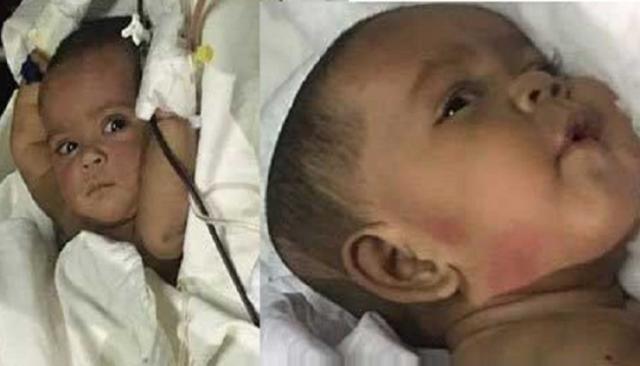
Tofa and Tahura Begum
 Bangladesh
- Successful Separation of Bangladeshi Conjoined Twins
- Complex Procedure and Recovery
- Landmark Surgery in Bangladesh
- Challenging Cases and Future Surgeries
- Delicate and Risky Procedure
- Survival Rates and Post-Operative Care
- Pre-operative Assessment and Rehabilitation
Successful Separation of Bangladeshi Conjoined Twins
Ten-month-old twin girls, who were conjoined at the spine and rectum, were successfully separated in a "groundbreaking" surgery. The conjoined twins, Tofa and Tahura Begum, underwent the groundbreaking separation procedure at Dhaka Medical College Hospital (DMCH).

Complex Procedure and Recovery
The delicate surgery involved two dozen surgeons, who are believed to be the first to have successfully separated conjoined twins in Bangladesh. According to local reports, the twins will require two more surgeries to reconstruct their internal organs. Despite the "100% success," the twins will remain in intensive care for several weeks to avoid life-threatening infections. Pediatric surgeon Abdul Hanif stated that "the twins are in stable condition after the nine-hour-long procedure."
Landmark Surgery in Bangladesh
"This is the first successful separation of conjoined twins in Bangladesh," said Dr. Hanif. "This surgery is groundbreaking in our medical history. It was a colossal task." Born to impoverished parents in a remote part of Bangladesh, the twin sisters were brought to the DMCH a month ago. Their mother, Shahida Begum, broke down in tears after the surgery. She was overwhelmed with both relief and joy upon hearing about the successful separation of her daughters.
Challenging Cases and Future Surgeries
Shahida said, "The doctors said the surgery was successful, but they are still vulnerable. I pray to Allah for my children's quick recovery. May their pain go away." Currently, another set of Bangladeshi twins, who are conjoined at the skull, are preparing for a similar complex separation surgery at the same hospital. The undertaking is unprecedented in Bangladesh, and doctors are consulting with experts worldwide during the preparation process.
Delicate and Risky Procedure
Doctors are trying to determine if the one-year-old twin girls, who were born healthy in northwestern Bangladesh, share a single brain. Such a discovery would significantly complicate the situation. Surgically separating conjoined twins is a complex and risky procedure that requires extreme precision and caution. The decision to separate twins is not made in all cases.
Survival Rates and Post-Operative Care
The survival rates for conjoined twins undergoing separation vary depending on where they are joined and which internal organs they share. For instance, there have been no successful separations when the twins shared a heart with fused pumping chambers. In recent years, success rates have improved, but surgical separation is still relatively rare. Since 1950, at least one of a pair of separated twins has survived in 75% of cases.
Pre-operative Assessment and Rehabilitation
Only after the twins are born can doctors use magnetic resonance imaging, ultrasound, and angiography to determine which organs connect the twins. Doctors must meticulously understand how the twins' shared internal organs function to determine the feasibility of separation. After the separation surgery, many twins require extensive rehabilitation due to spinal deformities and underdeveloped muscles. The muscles of the back in conjoined twins are permanently fixed in a bent position, making it challenging for them to bend forward and backward and hold their backs straight after separation.


