Ueti Kambun
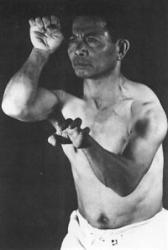
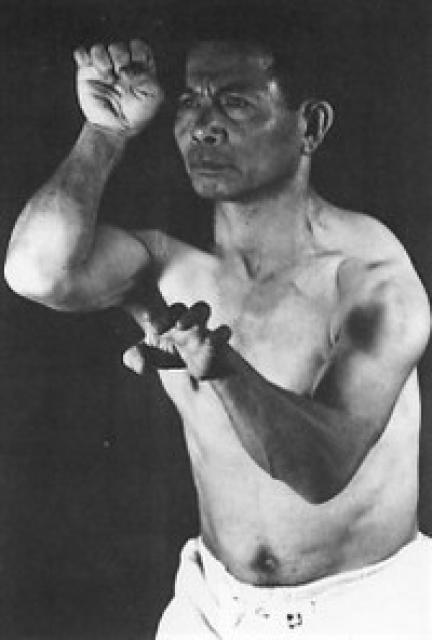
Kanbun Uechi, also known as Ueti Kambun, was an Okinawan martial artist whose teaching gave rise to Uechi-ryu, one of Okinawa’s major karate traditions. He brought together the techniques he learned in southern China with the discipline and training methods he developed over decades of teaching.
From Okinawa to Fujian
Uechi was born on May 5, 1877, in Izumi, in Okinawa’s Motobu region. In 1897, at about twenty years old, he traveled to Fujian Province in China. Accounts suggest that he wanted to study martial arts and may also have wished to avoid military conscription.
In Fuzhou, he studied under the Chinese martial artist Zhou Zihe, also known in Japanese sources as Shushiwa. Uechi learned a system called Pangainun, often translated as “half-hard, half-soft.” Its practice included the forms Sanchin, Seisan, and Sanseiryu, as well as demanding exercises to condition the body. After years of study, Uechi taught in China before returning to Okinawa around 1910.
Teaching and the Growth of a Style
Back in Okinawa, Uechi initially farmed. He moved to Wakayama, Japan, in 1924 and began teaching a small group of students two years later. In 1932, he opened a public dojo, where he taught under the name Pangainun-ryu Karate-jutsu.
His son Kanei became one of his students and later helped carry the system forward. In 1937, Kanbun granted Kanei permission to teach. Around 1940, Kanei began calling the system Uechi-ryu, taking the family name as its style name.
A Distinctive Okinawan Karate
Uechi-ryu preserved clear connections to the southern Chinese methods Kanbun had studied. Its practice is known for close-range techniques, strong body conditioning, and the use of fists, feet, and open hands. Sanchin is central to training, combining posture, breathing, and focused tension.
Kanbun returned to Okinawa in 1946 and died on November 25, 1948, at the age of 71. His students and family continued teaching, and Uechi-ryu grew into an internationally practiced branch of Okinawan karate.