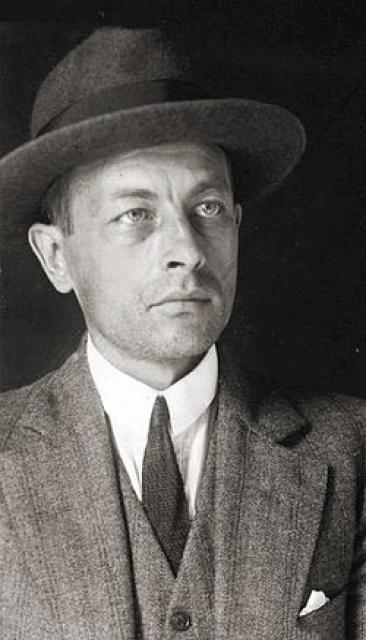
Ulian Golovinsky
- Early Life and Military Service
- Ukrainian Independence War
- Post-War Activities
- Leadership of OUN
- Arrest and Assassination
- Holovinsky was buried in Velyki Hlebovychi.
Early Life and Military Service
Julian Holovinsky was born in 1894 in the town of Radymno, Poland. His father, Mykola Holovinsky, was an Austrian postal official who passed away when Julian was young. His mother, Theophila, moved with her two sons to Lviv after her husband's death, where she worked as a private tutor.
Holovinsky received his secondary education at the gymnasium in Jarosław and passed his maturity exam in Lviv. With the outbreak of World War I, he enlisted in the Austrian army. As a lieutenant in the 30th Infantry Regiment, he fought on the Italian front from 1914 to 1918, earning the rank of lieutenant and several awards for bravery.
Ukrainian Independence War
After the end of World War I, Holovinsky moved to Lyubashiv, where his family was residing. Upon learning of the declaration of the West Ukrainian People's Republic, he began organizing Ukrainian military units in the Lyubashiv area. These units formed the basis for the 6th Ravska Brigade of the Ukrainian Galician Army (UGA), where Captain Holovinsky initially served as chief of staff and later as brigade commander.
As part of the UGA, Holovinsky participated in the November Campaign and became known for training his troops in lightning-fast maneuvers, giving the enemy little time to plan and inflicting heavy losses. He led the brigade across the Zbruch River and participated in the unification of Ukrainian armies and the capture of Kyiv on August 31, 1919.
Following the UGA's alliance with the Bolsheviks, Holovinsky played a key role in organizing its defection to the side of the Ukrainian People's Republic (UNR) in April 1920.
Post-War Activities
After the UGA's retreat south to Ukraine and later west to Poland, Holovinsky was captured and interned in Polish camps. He escaped and made his way to Prague, where he completed his education, earning a doctorate in veterinary medicine from Brno.
In 1924, he returned to Galicia and resumed his involvement in the liberation struggle as a member of the Ukrainian Military Organization (UVO). He served as deputy regional commander and боевой референт ("combat referent") under Yaroslav Indyshevsky.
After Indyshevsky's departure abroad in late 1924, Holovinsky became the regional commander of UVO and established the legendary "Flying Brigade." He personally participated in its operations, including the attack on the main post office in Lviv on March 28, 1925.
Arrested in 1927 for involvement in the assassination attempt on Polish curator-chauvinist Sobinsky, Holovinsky defended himself in court and was acquitted. However, Polish police remained suspicious and kept him under surveillance, leading to his dismissal as regional commander.
Holovinsky then founded a bus company with Osyp Matkivsky, enabling him to travel freely and continue his UVO activities.
Leadership of OUN
In the spring of 1930, Holovinsky became the regional leader of the Organization of Ukrainian Nationalists (OUN) in Western Ukraine. According to Matkivsky, he proposed several innovative tactics for anti-Polish resistance, including the use of gas, bacteriological weapons, and aviation.
Arrest and Assassination
Holovinsky was betrayed by Roman Baranovsky during an investigation into an attack on a postal transport carrying money near Bibirka. He was arrested in Lviv on September 20, 1930. After 10 days in prison, he was taken to Bibirka for identification.
On September 30, 1930, acting on orders from high-ranking police officials, police agent Radon tied the handcuffed Holovinsky to a tree near Hlebovychi and shot him three times in the chest and once in the head. His death was officially reported as having occurred during an escape attempt.