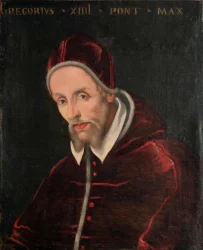
Clement X
- A late call to the papacy
- A pope and his adopted nephew
- Jubilee and relations with Europe
- A quiet reign in a changing church
Clement X became pope after a prolonged conclave settled on a candidate the cardinals believed would not dominate for long. Emilio Altieri was nearly eighty, and his six-year pontificate depended heavily on a younger adopted nephew who managed much of the papal government. The pope’s reign included the Jubilee of 1675 and several major canonizations, as well as continued conflict with powerful monarchs over the limits of church authority.
A late call to the papacy
Altieri was born in Rome on July 13, 1590, into a respected family. He studied law and spent decades in church administration and diplomacy, serving as a papal representative in Naples and Poland and later as bishop of Camerino. In 1669, Pope Clement IX made him a cardinal, shortly before his own death.
The conclave that followed lasted four months. Unable to agree on one of the leading candidates, the cardinals elected Altieri on April 29, 1670. He protested that he was too old for the responsibilities of the office, but accepted and chose the name Clement X in gratitude to the pope who had raised him to the cardinalate. At nearly eighty, he faced the challenge of governing the Papal States and navigating a European political landscape shaped by France, Spain, and the Holy Roman Empire.
A pope and his adopted nephew
Clement had no children, so he adopted the nephew of a relative, Paluzzo Paluzzi degli Albertoni, into the Altieri family. Paluzzo became a cardinal and took the Altieri name. He rose to a central role in the Curia, handling many of the day-to-day affairs of government as the elderly pope’s health declined. Critics saw this concentration of authority in the hands of a family member as nepotism, a familiar feature of early modern papal politics. Supporters valued Paluzzo’s administrative ability, but his dominance left the papacy closely tied to one household.
Clement’s government worked to improve the finances of the Papal States and encouraged commerce. He also took an interest in church administration and canonization. During his pontificate, the church declared several figures saints, including Rose of Lima, Francis Borgia, and Louis Bertrand. Their recognition carried particular importance in a period when Catholic devotion and missionary activity were expanding across the globe.
Jubilee and relations with Europe
In 1675, Clement presided over a Jubilee year that brought pilgrims to Rome. The event linked the city’s religious traditions with its role as a center of Catholic life, even as the pope’s age limited his personal participation. The celebration included the canonization of Bernardine of Siena, drawing additional crowds and renewed attention to Rome’s sacred sites.
Clement’s relations with European rulers were often tense. In France, Louis XIV advanced claims that extended royal control over church appointments and revenues. The papacy resisted attempts to reduce its authority, though the dispute continued beyond Clement’s reign. Such conflicts showed the growing strength of monarchies and the shrinking room for papal intervention in national affairs.
A quiet reign in a changing church
Clement X died in Rome on July 22, 1676, at age 86. He was not remembered as a forceful political strategist or a major reformer, but his years in office reflected important currents in the Catholic world: the prestige of the Jubilee, the global reach of sainthood, and the contest between church and state authority. His pontificate also exposed the tensions of a system in which family patronage could provide administrative continuity while concentrating power in ways that drew criticism.