Vasiliy Kochubey
- General Judge of Little Russia
- From Humble Origins to High Rank
- Mazepa's Patronage
- Love and Treachery
- The Denunciations
- Peter I's Reaction
- Execution and Legacy
- Memorials and Monuments
General Judge of Little Russia
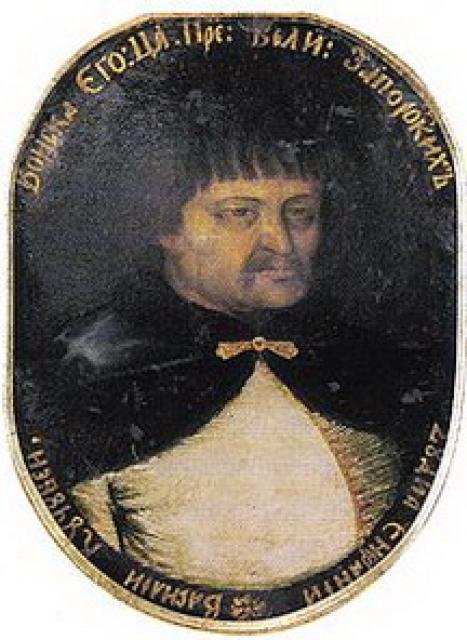
Vasyl Leontiyevich Kochubei served as the General Judge of the Zaporizhian Host, a military-political organization in the Hetmanate (Ukrainian autonomous state).
From Humble Origins to High Rank
Born around 1640, Kochubei was known for his diligence and proficiency in administrative affairs. He rose through the ranks of the Hetmanate's chancery, becoming the Regent of the Army Chancellery in 1681. In 1687, he was appointed General Writer, and in this capacity, he co-signed Hetman Mazepa's denunciation of his predecessor, Hetman Samoilovich.
Mazepa's Patronage
Mazepa's accession to the Hetmanate brought rewards for Kochubei. He received villages, including the famous Dykanka, and was appointed General Judge in 1694. In 1700, Mazepa secured for him the title of Stolnic, a Russian rank of nobility.
Love and Treachery
In 1704, a love affair between Mazepa and Kochubei's daughter Motria emerged. Despite Mazepa's attempts to marry her, Kochubei refused due to their godparent-godchild relationship. When Motria fled to Mazepa, he returned her to her parents unharmed.
The Denunciations
Kochubei, allegedly at his wife's behest, sent a verbal accusation against Mazepa through a wandering monk named Nikanor. However, an investigation found no evidence to support the charges. In 1708, a second accusation was sent through Peter Yatsenko, a Jewish convert. Mazepa learned of the plot but chose to take no action against the Kochubeys. They then sent a new accusation through their accomplices, Colonel Ivan Iskra and priest Svyatayla, to the Akhtyrka Colonel Osypov, who relayed it to Peter I through the Governor of Kiev.
Peter I's Reaction
Despite Mazepa's earlier disclosures about his plans for Little Russia's separation from Russia, Peter I remained skeptical of Kochubei's allegations. He ordered the arrest of Kochubei and Iskra and had them brought to Vitebsk for interrogation. Under torture, Kochubei confessed to falsely accusing Mazepa out of spite.
Execution and Legacy
Kochubei and Iskra were convicted of false denunciation and sentenced to death. They were beheaded on July 15, 1708, in the camp of Mazepa. Their bodies were buried in the Kiev-Pechersk Lavra. Peter I later acknowledged his error and ordered the return of the Kochubey family's confiscated properties.
The Kochubey family's coat of arms was augmented with a flaming heart and the motto "Elevor ubi consumer!" ("I rise up when I perish!"). Kochubei's story has been immortalized in Alexander Pushkin's poem "Poltava" and is considered a tragedy in Russian historiography.
Memorials and Monuments
In 1914, a monument to Kochubei and Iskra was erected in Kiev as a symbol of "the struggle for the Russian idea." After the Russian Revolution, the monument was dedicated to the heroes of the Arsenal Uprising. Today, it stands near the Arsenalna metro station.