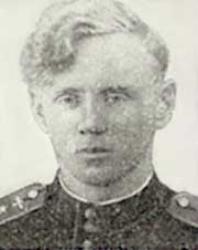
Vasily Gusev
 Uzbekistan
Biography of Vasily Gusev
Vasily Vasilyevich Gusev, a Soviet Hero of the Soviet Union, was awarded the title on November 17, 1943, for his bravery and courage demonstrated during the crossing of the Dnieper River, capture, and maintenance of a bridgehead on the western bank of the river. He was born on March 1, 1925, in the village of Podgorenka in the Rtishchevsky District of the Saratov region. Vasily Vasilyevich Gusev was a private and a machine gunner in the 1st Battalion of the 69th Mechanized Brigade (9th Mechanized Corps, 3rd Guards Tank Army, Voronezh Front). He completed seven years of school and worked as a tractor driver in the Takhata-Aral state farm in the South Kazakhstan region before being conscripted into the Soviet Army. From July 1943 to March 1944, he fought on the Bryansk, Voronezh, and 1st Ukrainian Fronts. He participated in the Battle of Kursk and the liberation of Ukraine. Gusev was wounded in 1943. He was awarded the Order of the Red Star (1943) and three medals for his combat achievements. The title of Hero of the Soviet Union with the award of the Order of Lenin and the medal "Golden Star" was bestowed upon Vasily Vasilyevich Gusev on November 17, 1943, for his bravery and courage demonstrated during the crossing of the Dnieper River, capture, and maintenance of a bridgehead on the western bank of the river.
Until 1947, V.V. Gusev served in the Soviet Army. He completed an automotive technical school. He lived in Navoi, Uzbekistan, and worked as an auto mechanic. On the evening of September 21, 1943, the first battalion arrived at the Dnieper River near Veliky Bukrin. Battalion commander Captain Baloyan announced that volunteers were needed to ensure the crossing and must be the first to cross the river during the night. Among the volunteers, 10 riflemen and a machine gun squad, including Vasily Gusev, were selected.
At dawn, the soldiers departed from the shore on log rafts. The Dnieper River was covered in fog, concealing the paratroopers from the sight of German observers. The rafts had already passed the middle of the river when German fighters suddenly flew along the river and began firing at them with machine guns. The soldiers jumped into the water and swam to the shore. Destroying the enemy machine gun crew, Gusev and his comrades set up a Maxim machine gun in a trench, opened fire along the trench, and killed about 15 German riflemen. Confusion arose among the Germans. A small piece of land, up to 200 meters in width and depth, was captured. Soon, a company of riflemen arrived at the bridgehead. With a joint attack and the support of artillery fire from the left bank, the soldiers defeated the enemy in the fortified position and liberated the village of Zarubentsy.
When the main forces of the 69th Mechanized Brigade were transported across the Dnieper, an offensive was launched to expand the bridgehead. With determined attacks, the Soviet soldiers drove the Germans out of the villages of Lukovitsy and Grigorovka. In the battle for the liberation of these settlements, Vasily Gusev destroyed up to 20 enemy soldiers and officers. The German command launched strong counterattacks with the aim of retaking the lost positions and eliminating the Soviet bridgehead in the Veliky Bukrin area. On the sector of the platoon commanded by Senior Lieutenant Mamedov, who defended the height of 214.9, the Germans launched a battalion-sized attack. The thick fog, limiting visibility, allowed the Germans, dressed in camouflage cloaks, to approach the platoon's positions at a very close range. Lieutenant Ryabchenko, the commander of the machine gun platoon, ran up to the Maxim machine gun on the hill. However, the ammunition had gotten wet during the crossing, and despite manually pulling the belt multiple times, the machine gun kept misfiring. At this time, a shell exploded nearby, severely wounding Ryabchenko and the machine gunner. The Germans ran towards them, shooting from their rifles as they advanced. Gusev rushed to the machine gun, inserted a new belt, and fired at the German riflemen at close range. He fired one belt, loaded another, and continued shooting until the enemy ceased their attack. In this battle, the courageous machine gunner destroyed another 25 Germans, ensuring the battalion held the strategically important height of 214.9.
In the battles near Zhytomyr, V.V. Gusev, who was commanding a machine gun detachment at the time, was seriously wounded and sent to a hospital for treatment.