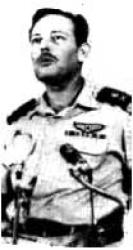
Victor Baranov
- Viktor Baranov: A Distinguished Soviet General
- Interwar Years and Military Education
- Pre-War Command and Staff Positions
- World War II
- Triumphant Advances and Heroic Leadership
- Post-War Career and Legacy
- Honors and Awards
- - Two Orders of Lenin
Viktor Baranov: A Distinguished Soviet General
Early Life and Military InitiationViktor Kirillovich Baranov was born on June 11, 1901, in the village of Sheremetyevka, Samara Oblast. From a modest peasant background, he completed three classes of education before working in a cotton factory in Uzbekistan.
In March 1918, Baranov was drafted into the Red Army. He fought on the Southern Urals against General A. I. Dutov's forces and later against the Basmachi and British in Central Asia. In 1918, he sustained a concussion.
Interwar Years and Military Education
In December 1920, Baranov became the head of the 31st Border Squadron for the Cheka. He studied at the cavalry school on Turkestan Front in October 1921, and after graduation joined the 15th Alma-Ata Cavalry Courses in December 1922.
Baranov continued his education at the 4th United Normal Cavalry School named after V. I. Lenin in Tashkent. He held various positions in the Central Asian Military District, participating in operations against Basmachi detachments. In 1929, he was awarded the Order of the Red Banner.
Pre-War Command and Staff Positions
In November 1929, Baranov attended the Novocherkassk Cavalry Courses for Advanced Command Training. Upon graduation in 1930, he returned to the 81st Cavalry Regiment, serving as a squadron commander and political instructor.
From June 1932, Baranov held positions in the Tajik Cavalry Regiment. In June 1934, he enrolled in the Frunze Military Academy. After graduating in December 1937, he was appointed chief of staff of the 1st Turkmen Mountain Cavalry Division.
Baranov rose through the ranks, becoming commander of the 27th Turkmen Mountain Cavalry Regiment and later assistant commander of the 3rd Cavalry Division. In March 1941, he was appointed commander of the 5th Cavalry Division in the Kiev Military District.
World War II
Outbreak of War and Combat ExperienceWhen the war broke out, Baranov remained in command of the 5th Cavalry Division. The division participated in defensive operations on the Southern and Southwestern Fronts.
In October 1941, the division was transferred to the Western Front, where it fought in the defense of Moscow. For its valor, the division was transformed into the 1st Guards Cavalry Division under Baranov's command in November 1941.
From January to June 1942, the 1st Guards Cavalry Division operated behind enemy lines. In July 1942, Baranov was promoted to commander of the 1st Guards Cavalry Corps.
Triumphant Advances and Heroic Leadership
Under Baranov's leadership, the 1st Guards Cavalry Corps distinguished itself in numerous operations, including the liberation of Kiev, Luhansk, and other key cities. For his exceptional courage and military prowess, he was awarded the title of Hero of the Soviet Union on May 29, 1945.
Post-War Career and Legacy
After the war, Baranov continued to serve as commander of the 1st Guards Cavalry Corps. In September 1946, he was appointed commander of the 14th Guards Rifle Corps. He furthered his education by attending advanced academic courses at the Voroshilov Higher Military Academy, graduating in November 1952.
Baranov retired from active duty in April 1953. He passed away on July 26, 1970, in Dnipropetrovsk and was laid to rest in the Alley of Heroes in Zaporizhzhia Cemetery.
Honors and Awards
- Hero of the Soviet Union with the Order of Lenin and the Golden Star Medal
- Two Orders of Lenin
- Five Orders of the Red Banner- Order of Suvorov 1st Class
- Two Orders of Bohdan Khmelnytsky 1st Class
- Order of the Patriotic War 1st Class
- Medals
- Foreign awards