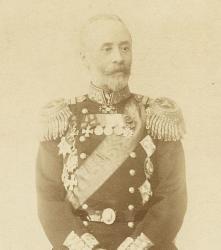
Benny Peled
 Israel
Biography of Beni Peled
Beni Peled, the former commander of the Israeli Air Force during the Six-Day War and the Entebbe operation, was born in 1928 in Tel Aviv. He began his career in aviation as a mechanic but quickly became one of Israel's first pilots after being tested in the fires of the 1948 battles. Starting with propeller planes like the Mustang and Spitfire, Peled transitioned to jet aircraft such as the Vampire and Meteor. In 1956, during the Sinai Campaign, his plane was shot down, and he became the first Israeli pilot to use an ejection seat. Despite being wounded in the leg, he managed to hide from Egyptian soldiers and wait for a rescue plane sent by Israel.
After studying aviation at an Israeli university, Peled was appointed as the commander of a strategic military airbase. It was there that he prepared and organized the Israeli Air Force's operation during the Six-Day War to completely destroy the Egyptian Air Force still on the ground.
During his tenure as the commander of the Israeli Air Force in 1973, just five months before the Yom Kippur War, Peled believed that Israel would be able to instantly destroy the Egyptian and Syrian planes, just as they had done in 1967. However, the Israeli Air Force suffered heavy losses, with over 100 planes being lost and hundreds of pilots killed, injured, or captured due to the concentrated Soviet missile systems primarily on the Egyptian front. After the war, Peled organized an independent reconnaissance unit for the Israeli Air Force, believing that the strategic failures were due to a lack of intelligence.
The peak of Beni Peled's career came during the brilliant operation at Entebbe on July 4, 1976. Israeli pilots rescued 103 Jewish passengers who had been held hostage by German and Arab terrorists in Uganda. The desperate situation of the Jewish hostages, coupled with the silence of the international community, vividly reminded the Jews of the recent Holocaust. However, this time they had their own state, and it came to the aid of their brethren located 4,000 kilometers away. A few hours before the terrorists' deadline, after which they planned to systematically murder the hostages, Israel dispatched four giant Hercules transport planes, two Boeing 707s, and several Phantoms to Uganda. 500 Israeli commandos were covertly deployed through Somalia to avoid Soviet radar detection. Leading the striking force, flying in a Boeing aircraft, were Beni Peled and Kutti Adam, the Deputy Chief of the General Staff. Their plane served as the mobile command center for the operation. The flight took place at night, without visual references or radio communication. The medical personnel involved in the operation also underwent special forces training.
While the operation was underway, Beni Peled's Boeing circled Lake Victoria. Just 53 minutes after the operation began, the aircraft carrying the freed hostages took off. Seven out of ten terrorists were killed, three were captured, all Soviet MiGs were destroyed, some radar station components were taken on board, and most of the remaining equipment, including the control and dispatch center, was destroyed. Israel managed to rescue all the hostages with minimal casualties: nine wounded and four killed, including the fearless Lieutenant Colonel Yoni Netanyahu, the older brother of the future prime minister.
The subsequent discussion in the Security Council addressed the "blatant violation of Uganda's sovereignty by Israel." Nevertheless, the main objective was achieved - the hostages were saved, and the terrorists received a worthy lesson. "If we could do this in Africa, we can do it anywhere. Israel can strike airports and oil fields in the countries harboring terrorists," said Brigadier General Dan Shomron, who commanded the special parachute unit involved in the operation. Through the Entebbe operation, the Israeli state demonstrated to the world that they felt responsible for the safety of any Jew, regardless of their location, and would come to their aid if necessary. After leaving the military, Beni Peled worked in the defense industry, serving as director of leading high-tech companies in Israel, such as Elbit and Elsin.
Speaking at a government meeting on July 14, Prime Minister Ariel Sharon described Beni Peled as an extraordinary individual and an outstanding pilot and commander who was entrusted with the most difficult missions during the most challenging times for the Jewish state and the Israeli Air Force.
Among Beni Peled's three children and eight grandchildren, two of his sons followed in their father's footsteps and became pilots.
In 1969, the British Prime Minister Harold Macmillan, speaking about the future of Great Britain, said that he would like to see his country resemble Israel because "quite recently while the world has been debating, Israel has imposed its will on its enemies. Israelis have everything that a great people needs: determination, courage, steadfastness, and pride. These are the things that truly matter both for individuals and nations."
Beni Peled possessed all of these qualities. May his memory be a blessing.